

.jpeg)
.png)
Back when Homestake Gold Mine was being converted to an underground research lab, I asked one scientist why people should care about the switch.
The transition from gold mine to science lab took several years. During those years, I reported on progress and wrote several news stories about the process and the people involved. I once covered a two-day gathering of several top-flight scientists. They met in Lead near the future lab to talk about experiments they hoped to perform a mile or more underground. They were talking about subatomic particles, neutrinos and dark matter, things like that. Now, I had physics in high school, but, boy, was I out of my element.
(As an aside, in earlier news trips to the mine, while the process of digging gold from deep in the earth was winding down, I did interviews with gold miners. I generally could follow their language. I hadn’t been a miner, but the people I interviewed painted detailed images of what it was like down there. And, I’ll never forget the long-time miner who, when I asked if he would seek another job working underground, snorted and said, “I’m never, ever, going to even own a home with a basement.’’)
But back to science. Eventually, I met a scientist who saw that I was struggling to comprehend what I was seeing and hearing. He broke things down in language I kind of understood – not the details, but at least some of the words. So, when he paused to consider how to cross the chasm in our respective levels of understanding of pure physics, I asked why people should care about experiments into things like dark matter, which as near as I could tell, nobody had seen. I felt rather foolish asking, but he took me seriously. He told of pure science research that, over time and through many laboratories, led to the global positioning stuff that, among many other things, allows us to push a button or two and find our way through the streets of an unfamiliar city.
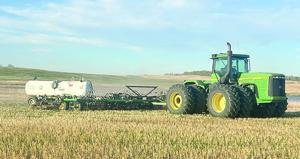
Then - and this was most of 20 years ago - he talked of farming, of South Dakota fields and crops, of developments that would let a person in a tractor dial in mixtures of seeds to plant, routes to take through the fields, allowances for soil types and moisture level, all sorts of factors that can affect the business of agriculture. I remember him saying something like, “There might come a time when the farmer can dial in all the necessary information and sit back to read a newspaper while science handles the job.’’ Clearly, he had a vision for agriculture that included considerable automation and computerization.
I told him of a couple of times when, as a teenager who had stayed too late in town the previous night, I half dozed through a morning on the tractor, basically relying on the front wheel of the John Deere to stay in the rut that had been cut by the last pass with the plow. Somehow, I managed to make the turns at the ends of the field. I told him I reckoned it would have been easier and safer if a computer system had been guiding me.
The whole drive home to Pierre after that gathering, I thought about that scientist and about how much automation might come to farming. When I was a farm kid 60 and 70 years ago, our machines did some of the heavy lifting. Even so, much of farming was done by humans, humans with scoop shovels and pitchforks and branding irons. Things have changed since then, changed in ways I could only imagine whenever I walked through machinery row at the State Fair and marveled at the tractors and implements of modern agriculture. Some of the inventions I see at the fair are nearly as foreign to me as some of the concepts and experiments expected to be part of the deep underground science lab in the Black Hills. A tractor isn’t a neutrino, but, wow, some of the stuff they have in the cabs these days. It might as well be dark matter for all I understand.
When it comes to farm memories, I think of grabbing a handful of wheat kernels from the hopper to chew into gum or plucking a thin stalk of brome grass and sticking it jauntily between my teeth like FDR and his cigarette holder. I don’t think science or automation will replace such moments. I sure hope they won’t.
Terry is a well-known regional columnist who lives in Chamberlain, S.D.
Catch the latest in Opinion
Get opinion pieces, letters and editorials sent directly to your inbox weekly!


.png)
