

.jpeg)
.png)
Committed to advancing sustainable farming practices, Arthur and Jennifer Walker have dedicated their efforts to improving forage production and soil health on their farm in Butte County, South Dakota.

Camelina sativa is an oilseed known as winter camelina.
Their cropping history has primarily consisted of forages, including alfalfa, alfalfa-grass mixes, sorghum-Sudan grass, millet and oats, as well as corn for silage. That is, until they tried, camelina sativa, also known as winter camelina. The cold-hardy, oilseed crop can be grown as a cover crop in the Upper Midwest.
The Walkers learned about winter varieties of camelina and wanted to test it as a sustainable rotational crop. With support from a Sustainable Agriculture Research and Education (SARE) Farmer Rancher grant and in collaboration with neighboring farmer Darin Durr, they planted side-by-side plots of camelina and winter wheat on both irrigated and dryland fields.
Despite severe drought, camelina performed well under irrigation, maturing earlier than wheat, using less nitrogen, and attracting pollinators. Their project highlights camelina’s potential to improve soil health and diversify rotations in semi-arid regions.
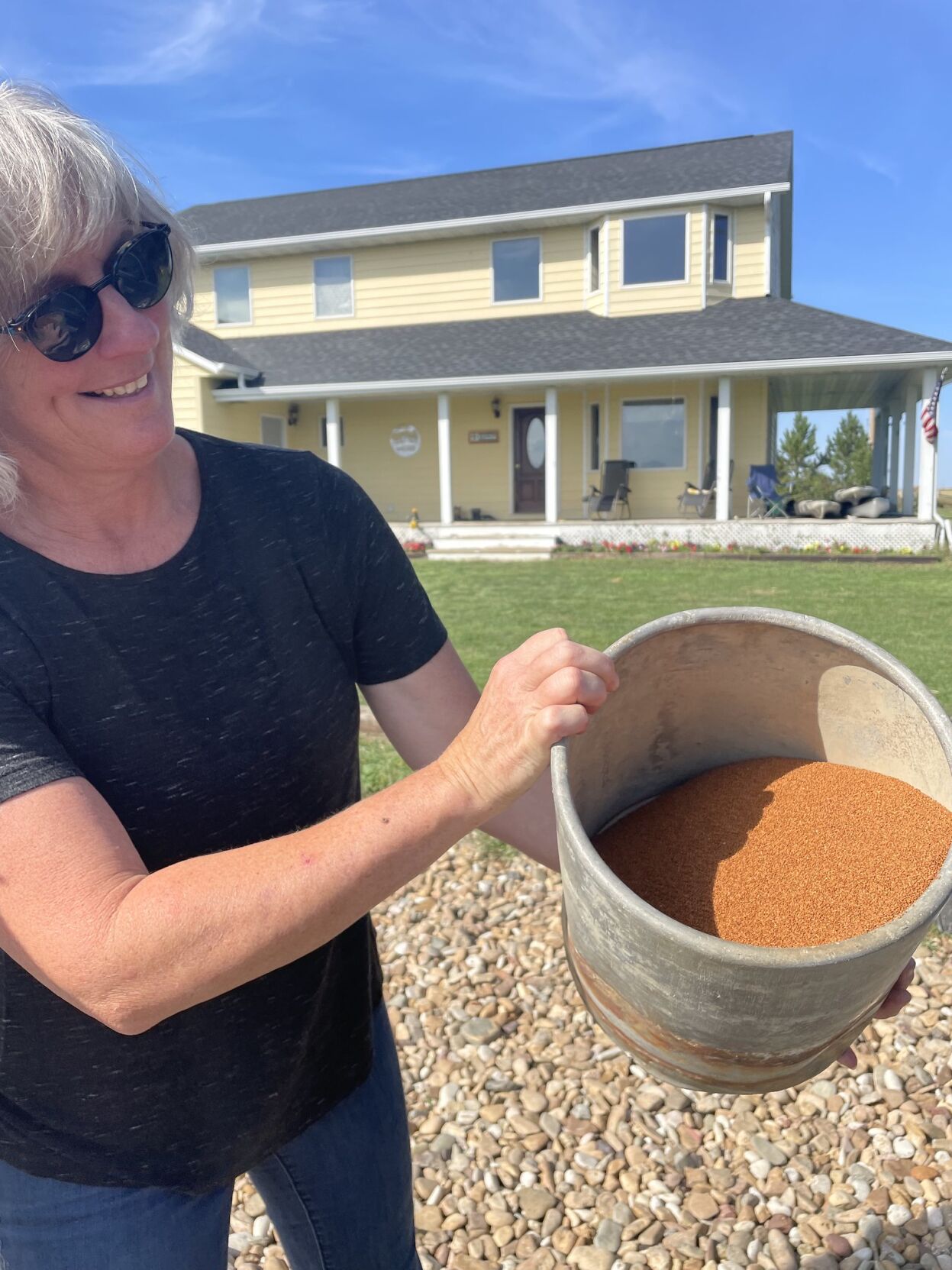
Jennifer Walker shows a bucket of camelina seeds. She worked on a SARE grant to test winter camelina as a rotational crop in South Dakota.
“Camelina is a crop with a long history of cultivation, which has attracted attention as a source of oil for biofuel,” said Jennifer Walker.
It’s also a source of omega-3 fatty acids, which has been recognized for its human health benefits. The unique characteristics of the camelina plant suggest that it could provide soil health and agronomic benefits in sustainable agricultural systems, as well, she said.
With winter varieties of camelina being developed, it could be an attractive crop in western South Dakota, Walker said.
Camelina versus winter wheat
In Walker’s trial, camelina and winter wheat were planted side by side under both irrigated and dryland conditions. Despite a severe drought, the camelina performed reasonably well under irrigation. It matured earlier than wheat, used less nitrogen, and left more residual soil nutrients. However, winter wheat appeared to do a better job with weed control, and camelina proved vulnerable to shattering during harvest, an area the team identified for future research.
Pollinator friendly planting
One of the most striking findings to Walker was the value of camelina to pollinators. Early in the season, more than 60 honeybees were collected in a single sweep net from flowering camelina, compared to just three from the wheat. In a drought year when little else bloomed, camelina provided a reliable food source for pollinators, underscoring its role in supporting beneficial insect populations.

Jennifer and Art Walked used a SARE grant to test growing camelina on their Butte County, S.D., farm.
Harvesting and market challenges
The Walkers believe that camelina has potential; however, they point out that harvesting the crop presents challenges due to its small seed size and tendency to shatter.
There’s no local market for camelina oil and meal, creating logistical and economic obstacles. These are other issues for further research.
Creative uses and future potential
The Walkers explored camelina’s potential beyond the field, using its oil in homemade products like lip balm and leather conditioner, which received positive feedback. They’re also interested in trying camelina meal as livestock feed. They plan to continue testing the role of camelina in relay cropping and soil conservation.
Their key takeaway for other farmers: success with camelina depends on planning every step, from planting to marketing.
Jennifer and Art Walker used SARE funding to test winter camelina as a rotational crop on their South Dakota farm. North Central Region-SARE’s Farmer Rancher Grant program starts accepting proposals in mid-August.
Be the first to know
Get local news delivered to your inbox!




.png)
