

.jpeg)
.png)
South Dakota officials and agricultural leaders will soon visit Ireland and the United Kingdom to talk trade, and with a new federal trade agreement in place, hopes are high for a positive outcome.
Farmers can help foster relationships and make such deals happen, especially when there’s an air of negativity and false advertising about U.S. products.
“It's crucially important to get the farmer involved in the trade negotiation,” said Luke Lindberg, newly appointed Undersecretary of Trade and Foreign Agricultural Affairs with the U.S. Department of Agriculture. “People want to do business with someone they like.”
Lindberg spoke at the Midwest Agricultural Export Summit in Sioux Falls Aug. 13.

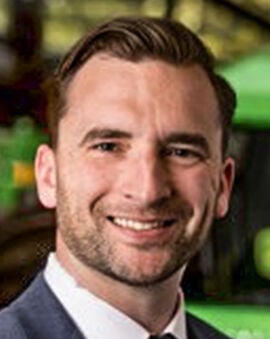
USDA Undersecretary of Trade and Foreign Agricultural Affairs Luke Lindberg says farmers play a critical role in making trade deals for U.S. agricultural products.
He commended the South Dakota Soybean Association for its role in helping find new markets.
Dave Iverson has hosted trade delegations at his farm Toronto, South Dakota. He sat in on the trade summit as vice chairman of the South Dakota Soybean Research and Promotion Council. He was encouraged to hear from trade representatives say they’re open to a reciprocal, respectful relationship.
“They’re wanting to business with us,” Iverson said.
The UK brokered one of the first trade deals with the Trump administration this spring. It did away with a 20% tariff on beef and raised a quota of 1,000 metric tonnes in U.S. beef imports to 13,000 metric tonnes, the BBC reported. Ethanol also had tariffs lifted on up to 1.4 billion liters.
UK Consul General Richard Hyde represented one of three countries on an export summit panel on reciprocal trade relationships. The UK needs to import food, he said. Its landmass is about 20% bigger than South Dakota, but it has 69 million more people to feed than the Rushmore State.

Consul General Richard Hyde of the United Kingdom talks about trade relations during the Midwest Agricultural Export Summit in Sioux Falls Aug. 13.
There’s no space to increase production, so UK farmers rely on efforts to boost yields, Hyde said. They look to the U.S. to learn about crop rotation, technology and handling weather challenges.
“We want farmers to talk about how to work together so they don’t fear each other,” he said. “We’re not in competition with the United States.”
The U.S. is also eyeing India, given its large, young population and fast-growing economy. Along with Kenya, India was the other country represented on the export summit panel.
It was Consul General Prakash Gupta’s second visit to South Dakota this year. India is interested in distillers grains, ethanol, cheese, whey protein, oats and other products from South Dakota. In exchange, he’d like to see mango, pomegranate, coffee, whiskey and wine from India on American grocery store shelves.
Kenyan Ambassador Christopher Kirigua said his country’s flowers and tea are sold in the U.S., but they go through a broker in Europe first. He said that's unfair to both consumers, who pay higher prices, and to farmers, who make less for what they grow.
“We need to have direct access to markets,” he said.
Kenya also has a young, growing population, and offers an investment opportunity for American companies, he said.
Sending American products like beef to the UK will take getting foreign consumers familiar with products and production practices, Hyde said.
U.S. products face stigma, sometimes stemming from concerns about outdated food processing practices.
“Bad players use that as a reason to keep our products out of imports,” said Greg Tyler, president and CEO of the USA Poultry and Egg Export Council.
It’s something the poultry industry faced with bird flu, and with an old practice of using highly chlorinated water to kill bacteria in the processing plant. That’s been banned in Europe since 1997 and is no longer used at most U.S. plants. Tyler said countries are starting to lift their bans on U.S. poultry products.
“That pressure from the Trump administration is helping,” he said.
The dairy industry faces misinformation, too, from those trying to protect their country’s farm economy. In India, consumers are told that U.S. dairy cows eat cat meat and chicken poop, said Jaime Castanada of the National Milk Producers Federation and U.S. Dairy Export Council.
In the beef industry, Australians paint American beef as the product of factory farms. And Mexico not long ago banned genetically modified corn from the U.S.
“You would think some of these countries are artists, they’re so creative at shutting out our products,” said U.S. Rep. Adrian Smith, R-Neb.

Nebraska Gov. Jim Pillen and Kimberly Reed, former president and chairwoman of the Export-Import Bank of the U.S. talk during an agricultural export summit in Sioux Falls Aug. 13.
Still, trade missions are making strides on exporting U.S. meat, including to countries where much of the population are vegetarian or don’t eat beef or pork for religious regions. In Indonesia, Gov. Jim Pillen, who’s in the hog business himself, was part of a trade team that held a pork demonstration with local chefs.
Building those relationships helps push back on false ideas, said Hunter Roberts, secretary of the South Dakota Department of Agriculture and Natural Resources. As he prepares to head to the UK next week, he said his role is to continue fair trade.
“States continue to beat that drum,” he said.
Raised in small town South Dakota, Janelle is enjoying her time as editor of Tri-State Neighbor and Midwest Messenger while raising kids, chickens and no till vegetables in central Sioux Falls. Reach her at janelle.atyeo@lee.net.
Be the first to know
Get local news delivered to your inbox!




.png)
