
 3 weeks ago
30
3 weeks ago
30

.jpeg)
.png)
Press play to listen to this article
Voice
For many African farmers, producing excellent crops or livestock is only half of the business journey because finding reliable buyers often determines whether hard work becomes genuine profit.
Traditional markets remain important, but farmers can now use smartphones, messaging applications, social networks, online marketplaces, and digital payment options to reach customers beyond their immediate communities.
Learning how to sell your farm products online allows farmers to present their produce directly to households, restaurants, supermarkets, food vendors, processors, offices, schools, and other institutional buyers.
The goal is not simply posting photographs and waiting for messages. Successful online farm selling requires attractive presentation, accurate pricing, dependable communication, efficient delivery, consistent quality, and deliberate customer relationship management.
Adunola, a vegetable farmer in Ibadan, illustrates this opportunity. After creating a WhatsApp Business account, presenting fresh vegetables professionally, and contacting existing customers, she gradually developed a dependable weekly customer base.
Her experience demonstrates an important principle: digital marketing does not necessarily require expensive equipment or complicated technology. A smartphone, reliable internet connection, attractive presentation, and disciplined follow-up can transform farm sales significantly.
🌿 Go Organic on Your Farm: Instead of harmful chemical pesticides and fertilisers, try our organic farming products — including neem oil spray, bio-pesticides, natural plant treatments, organic seeds and seedlings, suckers, and many more organic products that are safe for your health, your family, your soil and your harvest. Shop Now →
Prepare Farm Products for Online Sales

Before promoting anything online, make sure your farm products are genuinely ready for customers. Digital promotion can create demand quickly, but poor quality, inconsistent sizes, or unreliable availability can destroy trust just as quickly.
1. Know Your Buyer: Decide whether you want households, restaurants, retailers, processors, schools, hotels, food vendors, wholesalers, or other farmers because each group expects different quantities, packaging, prices, and delivery arrangements.
A household may want a small basket of mixed vegetables, while a restaurant may require predictable weekly quantities. Understanding those differences helps you design product packages that match real purchasing behavior.
Your online strategy should therefore begin with a clear customer profile rather than random posting. Identifying your preferred buyers also helps you choose appropriate digital channels and communicate benefits using language they understand.
🔧 Free Farm Tool Available: Use our free Agric4Profits Farm Tools to calculate your farm profits, formulate feeds, identify pests and diseases on both your crops and animal farms, plan your planting and harvesting season, including many more farm tasks to get free expert advice and recommendations — completely free, no registration required. Access Free Tools →
2. Grade Your Produce: Sort harvested products according to quality, maturity, size, cleanliness, and appearance before photographing or advertising them, because customers should receive products that closely match what they viewed online.
Careful grading also makes pricing easier because premium products can command different prices from ordinary grades. Consistent grading supports customer confidence and reduces complaints caused by unexpected differences between advertised and delivered produce.
Proper preparation should include sorting, cleaning where appropriate, gentle handling, and suitable packaging. Fresh produce can lose quality rapidly after harvest, making post-harvest discipline essential for profitable online selling.
3. Reduce Post-Harvest Losses: Protecting produce after harvest is part of digital selling because damaged vegetables, bruised fruits, wilted leaves, or poorly stored products quickly reduce customer satisfaction and repeat purchases.
Farmers can strengthen these practices by studying post-harvest handling methods covering the movement of horticultural products from harvest through preparation, storage, transportation, and marketing.
💬 Have a Farming Question? Join thousands of farmers across Africa on the Agric4Profits Community — ask questions, share experiences and connect with agricultural experts. It is completely free. Ask Your Question Now →
Fresh produce remains biologically active after harvest, so heat, moisture loss, rough handling, unsuitable storage, and delayed transportation can reduce appearance and market value before customers ever receive their orders.
Farmers should also study post-harvest loss prevention because reducing waste effectively increases saleable output without necessarily expanding production acreage, labour requirements, or input expenses.
4. Package for Delivery: Online customers expect products to arrive clean, organized, protected, and attractive, so packaging should be treated as part of your product rather than an afterthought.
Strong packaging protects produce from bruising, compression, contamination, moisture loss, and rough transportation while creating a more professional impression. Different commodities require different packaging materials and ventilation arrangements.
Farmers can review farm-fresh produce packaging practices to understand how appropriate containers can protect quality, support efficient handling, improve presentation, and reduce losses during market distribution.
For additional guidance, fresh produce distribution packaging can help farmers choose containers according to distance, transportation conditions, commodity characteristics, and the expectations of intended buyers.
Read Also: Meaning and Importance of Agricultural Marketing
Use WhatsApp Business to Sell Farm Products

WhatsApp Business can become the foundation of a small farm's digital sales system because it combines customer communication, product presentation, order conversations, status updates, and business information inside one familiar mobile application.
1. Create a Professional Profile: Use a dedicated business number where possible, then add your farm name, location, business description, operating hours, product categories, and other information that helps customers understand what you offer.
📖 Want to Go Deeper on This Topic?
Our expert agricultural ebooks cover poultry, fish farming, different crops production, snail farming, organic farming, mushrooms, sheep, cattle, flowers, pig farming, goat farming, agribusiness, etc. in practical step-by-step detail — written by agricultural professionals for African farmers.
Your profile should immediately answer basic buyer questions such as what you sell, where you operate, when customers can order, and whether delivery is available within their area.
A professional profile creates stronger first impressions than a personal account containing unrelated conversations, family photographs, forwarded messages, and random status updates. Your digital storefront should look intentional and trustworthy.
2. Build Your Catalogue: Add clear photographs, product names, descriptions, prices, available sizes, and relevant purchasing details for every farm product that customers can order regularly.
Describe products honestly and specifically. Instead of writing “fresh vegetables,” explain whether customers receive spinach, amaranth, tomatoes, peppers, onions, or mixed baskets, including approximate quantities where appropriate.
Your catalogue should change whenever products, prices, sizes, or availability change. Outdated information creates unnecessary conversations and can make customers doubt whether the business is actively managed.
3. Use Daily Status Updates: Show what is available each morning using photographs, short videos, prices, quantities, harvesting activities, customer orders, and delivery preparations that make your farm feel active and authentic.
Consistent visibility matters because customers rarely purchase immediately after seeing one advertisement. Repeated exposure reminds them that your farm exists and gives them multiple opportunities to act when they need produce.
Instead of posting only sales messages, mix product announcements with farm stories, harvesting videos, cooking suggestions, customer feedback, packaging demonstrations, and simple educational content related to your products.
4. Make Ordering Simple: Create a straightforward ordering process that tells customers exactly what information to send, including product, quantity, location, preferred delivery time, and payment preference.
You can use a simple message such as, “Send the product name, quantity, delivery location, and preferred delivery day.” Simple instructions reduce back-and-forth conversations and help you process several orders efficiently.
Farmers who want stronger marketing foundations can study effective farm product marketing principles, especially customer identification, communication, relationships, market diversification, and methods for connecting products with suitable buyers.
It is equally useful to understand the broader concept of agricultural marketing because online selling is still marketing: it connects production with customer needs through communication, exchange, distribution, and value creation.
5. Follow Up Promptly: Customers appreciate quick responses because farm products are often time-sensitive, particularly vegetables, fruits, milk, fresh fish, meat, and other highly perishable commodities.
Prepare standard replies for availability, prices, delivery charges, payment instructions, order confirmation, and customer complaints. This saves time while ensuring customers receive consistent information regardless of when they contact you.
Create Content That Converts Farm Products

Online customers cannot physically inspect your farm before purchasing, so your photographs, videos, descriptions, prices, customer reviews, and farm stories must communicate the quality buyers would normally evaluate in person.
1. Photograph in Natural Light: Take product photographs during bright morning hours or near a well-lit window, avoiding harsh shadows, darkness, clutter, dirty backgrounds, and distracting objects around the produce.
Fresh vegetables should look genuinely fresh rather than artificially enhanced. Clean presentation, natural colours, visible texture, appropriate moisture, and realistic quantities help customers develop accurate expectations before placing orders.
Use simple backgrounds such as clean cloth, a tidy wooden surface, a neat harvest table, or a clean farm environment. Your smartphone camera is usually sufficient when lighting and composition are strong.
2. Show Quantity Clearly: Buyers need to understand what their money purchases, so photograph baskets, bags, bunches, trays, crates, or packaged units in ways that communicate approximate quantity and presentation.
Descriptions should clarify weight, size, count, or package dimensions whenever practical. This reduces misunderstandings and makes it easier for buyers to compare your offer with competing products.
3. Put People Behind the Farm: Occasionally show yourself, farm workers, harvesting activities, packaging, delivery preparation, or normal farm operations because people often trust identifiable businesses more readily than anonymous product photographs.
Do not manufacture dramatic stories or exaggerated claims. Authenticity works better over time because customers can see that your online presentation matches the actual farm and products they receive.
4. Use Useful Captions: Each post should explain the product, quantity, price, availability, delivery area, ordering method, and one practical reason customers should consider buying from you.
For example, instead of writing “Fresh tomatoes available,” write “Freshly harvested tomatoes available today in five-kilogram baskets. Delivery available within Ibadan. Message us before noon for same-day dispatch.”
Your selling language should focus on real customer benefits such as freshness, convenience, consistency, traceability, farm origin, reliable quantity, hygienic handling, or direct access to the producer.
Farmers can strengthen their understanding by reading the role of agricultural marketing, particularly the importance of understanding customer preferences and continuously earning a product's position within the market.
They can also review modern farming market principles to understand direct selling, customer relationships, locally produced goods, and the importance of connecting farmers with consumers.
5. Protect Your Brand Reputation: Never advertise produce you cannot supply, manipulate photographs excessively, hide product defects, invent customer testimonials, or promise delivery times you cannot consistently achieve.
A single misleading advertisement can generate immediate sales, but it can also create refunds, complaints, negative reviews, and lost customers. Honest marketing produces slower growth initially but stronger long-term relationships.
For farmers selling processed, packaged, or branded products, understanding different agricultural packaging options can help improve protection, presentation, communication, convenience, and customer appeal throughout the buying journey.
Choose Online Marketplaces and Delivery Channels

WhatsApp can become your primary channel, but relying on one platform alone limits your reach. A stronger digital sales system combines direct communication with social media, marketplaces, referrals, and offline partnerships.
1. Expand Beyond WhatsApp: Consider Instagram for visual promotion, Facebook Marketplace for public listings, appropriate local classifieds, farming communities, business groups, and agriculture-focused platforms available within your country.
Choose platforms according to your target customers rather than trying to maintain every social network simultaneously. A farmer with limited time may perform better on two channels used consistently.
In Nigeria, farmers may also explore suitable online classified or agricultural marketplaces where buyers actively search for farm products. Always verify platform policies, buyer quality, transaction arrangements, and service charges.
2. Choose Direct Marketing Channels: Direct producer-to-consumer selling can reduce unnecessary intermediaries, strengthen customer relationships, provide better knowledge about customer preferences, and give farmers greater control over product presentation.
However, direct selling requires farmers to handle communication, packaging, transport, payment confirmation, customer service, and sometimes returns. The higher selling price must therefore be compared with the additional responsibilities.
The principles described in agricultural marketing channels help farmers understand how products move from producers toward consumers and why shorter channels can sometimes be appropriate for highly perishable products.
3. Price for Profit: Do not copy another seller's price blindly because your production costs, transportation distance, packaging quality, labour costs, wastage, and desired profit margin may be different.
Calculate production costs, packaging costs, delivery expenses, platform charges, payment charges where applicable, expected losses, and profit requirements before publishing your price list.
Understanding pricing decisions in agricultural marketing can help farmers evaluate changing costs, customer demand, competition, purchasing power, and other factors affecting sustainable pricing decisions.
4. Build a Delivery System: Start with a manageable delivery radius around your farm or primary customer area, then expand when order volume, vehicle availability, staffing, and delivery costs can support reliable service.
Urban farmers can negotiate rates with dispatch riders, local delivery operators, motorcycle services, tricycle operators, or other transport providers. Agree clearly on collection time, destination, charges, waiting periods, and proof of delivery.
For distant buyers, consider suitable parcel services, agricultural logistics providers, scheduled transport networks, or buyer-arranged collection. Always evaluate how long the journey takes because perishability can determine whether a delivery remains commercially worthwhile.
The principles in agricultural marketing functions explain how transportation, packaging, storage, processing, selling, and other activities help move farm products toward final consumers.
5. Protect Against Delivery Problems: Confirm orders before dispatch, verify customer addresses, photograph packed orders when appropriate, communicate delays promptly, and keep delivery records that show what was sent and when.
New customers may prefer payment upon delivery, while established customers may accept transfers before dispatch. Select payment arrangements according to your risk tolerance, customer history, product perishability, and transaction value.
Storage can also support online selling when products do not need immediate delivery. Farmers can study storage life of harvested crops to understand how quality and shelf life influence marketing decisions.
Where storage is practical, farmers can sometimes avoid distress selling immediately after harvest. However, storage should be economically justified because facilities, handling, spoilage, labour, security, energy, and financing all contribute to its actual cost.
Read Also: How to Improve Agricultural Marketing Strategies
Increase Farm Sales With Repeat Customers

The most valuable online customer is often not the person who purchases once, but the buyer who returns repeatedly because your quality, price, communication, and delivery have consistently met expectations.
1. Deliver Exactly What You Promised: Customer loyalty begins with consistency. The photograph, product description, quantity, quality, price, and delivery arrangement should closely match what the customer experiences after placing an order.
When something changes unexpectedly, communicate before delivery rather than allowing the customer to discover the problem after receiving the order. Transparency protects trust during difficult situations.
2. Add Small Customer Bonuses: A small extra bunch of herbs, a few peppers, a complimentary sample, or a handwritten thank-you message can make a first purchase feel more personal and memorable.
The bonus does not need to be expensive. Its purpose is to communicate appreciation and encourage customers to remember your business positively when they need farm products again.
3. Request Customer Feedback: Follow up after delivery and ask whether the produce was fresh, whether the quantity was correct, whether delivery arrived as expected, and what could improve next time.
Feedback can reveal product preferences, preferred delivery times, packaging problems, pricing objections, unavailable products, and opportunities for new product bundles that you may otherwise overlook.
Keeping accurate information about customers and orders also becomes easier when you maintain proper records. Farmers should review farm recordkeeping practices to understand the information that supports better management and financial decisions.
4. Encourage Referrals: Satisfied customers can introduce your farm to neighbours, colleagues, relatives, community groups, restaurants, offices, and other buyers who already have some reason to trust their recommendation.
Ask politely for referrals after successful purchases. You might write, “We are glad you enjoyed your order. Please share our number with anyone who would appreciate fresh produce delivered to their home.”
Referral programmes can also offer modest incentives, such as discounts on selected products or small bonuses after a successful referral. Keep the system simple enough that customers understand it immediately.
5. Create Weekly Farm Offers: Regular bundles can simplify buying and increase order value. Examples include vegetable baskets, soup ingredient packs, fruit boxes, pepper combinations, egg trays, fresh fish packages, or mixed farm boxes.
Bundles should solve a customer problem rather than merely combine random products. A useful weekly basket could contain commonly purchased ingredients that save customers time when planning household meals.
Farmers can also use market information to adjust bundle contents according to harvest availability, seasonality, customer demand, and expected supply. This can reduce unsold produce while giving customers convenient purchasing options.
Learning about marketing functions in agriculture can help farmers understand selling, transportation, storage, processing, standardisation, financing, risk bearing, and other activities that influence the final movement of farm products.
6. Monitor Your Profit: Online sales can increase revenue while secretly reducing profit if delivery charges, packaging expenses, discounts, customer acquisition costs, spoilage, refunds, and unpaid orders are not tracked carefully.
Record every online order, product quantity, selling price, production cost where known, packaging expense, delivery charge, payment received, customer acquisition source, and final profit or loss.
Studying marketing margins in agricultural markets can also help farmers understand the difference between prices at different stages of agricultural distribution and how value changes as products move through markets.
7. Expand Gradually: Once online orders become consistent, consider increasing production, hiring delivery assistance, improving packaging, adding complementary products, serving institutional buyers, or developing a recognizable farm brand.
Expansion should follow evidence rather than excitement. Review your records first, identify your strongest products and customer groups, calculate actual margins, and determine whether additional sales can be fulfilled without damaging quality.
Farmers interested in reducing dependence on fresh-market prices can also investigate value addition. traditional food processing methods illustrate how agricultural products can sometimes be processed to improve storage options and market availability.
Online selling is ultimately a business system rather than a single social media post. When production, presentation, marketing, pricing, delivery, customer service, and recordkeeping work together, digital sales become more sustainable.
Adunola's experience offers the central lesson. She did not necessarily need a larger farm first; she needed a better path between her existing harvest and customers willing to purchase it directly.
The same principle can apply across African agriculture, whether the farmer produces vegetables, fruits, grains, eggs, poultry, fish, milk, honey, livestock products, herbs, flowers, or processed agricultural goods.
Start with the products you can supply consistently, present them professionally, communicate clearly, deliver reliably, track your numbers, and build relationships with every satisfied customer who purchases from you.
When these activities become routine, your smartphone stops being merely a communication device and becomes a practical sales channel that can connect your farm directly with profitable local and regional markets.
Summary on How to Sell Your Farm Products Online and Make More Money
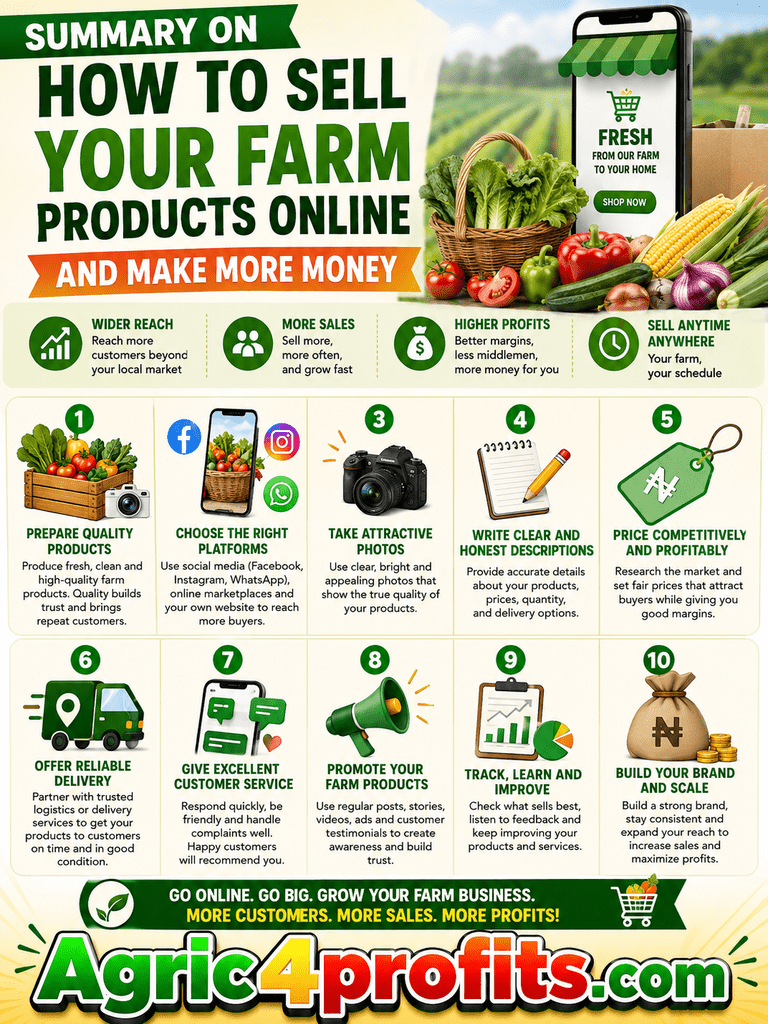
| Product Preparation | Grade, clean, handle, package, and protect produce. | Better quality and fewer complaints. |
| WhatsApp Business | Create a profile, catalogue, status updates, and simple ordering process. | Direct customer communication and easier sales. |
| Product Content | Use natural light, clear photographs, useful captions, and authentic farm stories. | Greater attention and stronger buyer confidence. |
| Online Channels | Combine WhatsApp with suitable social media, marketplaces, and community channels. | Wider market reach and diversified customers. |
| Pricing | Calculate production, packaging, delivery, losses, platform expenses, and profit. | More sustainable margins. |
| Delivery | Use reliable local dispatch and suitable transport arrangements. | Better customer experience and fewer delivery problems. |
| Customer Loyalty | Follow up, request feedback, offer useful bonuses, and encourage referrals. | More repeat purchases and lower marketing costs. |
| Recordkeeping | Track orders, revenue, expenses, customers, and product performance. | Better decisions and clearer profitability. |
Frequently Asked Questions About How to Sell Your Farm Products Online for More Profit
1. What is the easiest way to sell farm products online when starting with little money?
WhatsApp Business is a practical starting point because farmers can create product listings, communicate with existing contacts, publish status updates, answer enquiries, confirm orders, and coordinate deliveries using one smartphone.
2. Do I need a website before I can sell my farm products online successfully?
No. A website can strengthen your brand later, but farmers can begin with WhatsApp Business, social media pages, suitable marketplaces, customer referrals, and direct communication while building their digital presence gradually.
3. What should farmers include in online farm product photographs before publishing them for customers?
Use natural lighting, clean backgrounds, realistic colours, visible quantities, attractive arrangements, and occasional photographs showing your farm or harvesting process so customers can better understand the product and producer.
4. How should I determine the right online selling price for my farm products?
Calculate production costs, labour, packaging, transportation, expected spoilage, platform charges, payment costs, discounts, and desired profit before comparing your resulting price with competing sellers and current market conditions.
5. How can farmers deliver fresh vegetables and other perishable products ordered online?
Use reliable local dispatch riders, agricultural logistics services, suitable public transport arrangements, or buyer-organised collection while selecting packaging that protects freshness, minimizes physical damage, and supports efficient transportation.
6. How can I attract repeat customers instead of constantly searching for new buyers?
Provide consistent quality, communicate promptly, deliver when promised, follow up after purchases, request feedback, offer occasional bonuses, create useful product bundles, and encourage satisfied customers to recommend your farm.
7. Which farm products are suitable for online selling in African markets?
Many products can work online, including vegetables, fruits, eggs, poultry, fish, honey, grains, herbs, flowers, livestock products, seedlings, spices, processed foods, and other goods that can be packaged and delivered reliably.
8. What is the biggest mistake farmers make when trying to sell farm products online?
One major mistake is treating online selling as occasional advertising instead of a complete business process involving product quality, customer targeting, pricing, presentation, communication, delivery, follow-up, records, and continuous improvement.
Do you have any questions, suggestions, or contributions? If so, please feel free to use the comment box below to share your thoughts. We also encourage you to kindly share this information with others who might benefit from it. Since we can’t reach everyone at once, we truly appreciate your help in spreading the word. Thank you very much for your support and for sharing!
Read Also: How to Make an Avocado Tree Bear Fruit








.png)
