

.jpeg)
.png)
Key takeaways
- Dynamic LED spectrum raised greenhouse strawberry yield 11–25% over fixed spectrum at KPU, depending on cultivar; at Biophi, flexible spectrum beat stable spectrum by 6–17%.
- Biophi's best group reached 22 kg/m² over a 43-week winter season, with 4.4 kg/m² harvested by December 31 and 8.4 kg/m² by Valentine's Day.
- Red light built fruit size (+20% fruit weight); blue light built sweetness (+29%) and color (+67% anthocyanins); far-red opened the canopy.
- Both trials targeted a DLI of 18–20 mol/m²/day, above the older 14–15 rule of thumb.
- Cultivar and climate decide the recipe: treat any published recipe as a starting hypothesis.
Strawberries are becoming an important crop for controlled-environment production, and breeding
companies keep releasing new cultivars that respond differently to light, climate, and nutrition. Plant physiology has long established that crops react to specific wavelengths. The harder part is turning those responses into measurable commercial outcomes in a working greenhouse, where yield, fruit quality, energy cost, and labor all compete.
The conversation has also moved on from how much light to which light, and when. For years, the rule of thumb for greenhouse strawberries was a daily light integral (DLI) of about 14 to 15 moles per day. With newer cultivars, the trials discussed here targeted 18 to 20 moles, and Sollum's team has seen responsive cultivars take up to 22. Over the last two years, four-channel dynamic LED lighting, which changes spectrum through the day and across crop stages, has been tested against fixed-spectrum LEDs in North America and Europe, with similar responses showing up on both continents.
In September 2026, Sollum Technologies hosted a webinar, built on season-long studies run with Kwantlen Polytechnic University (KPU) and Biophi, that put two research groups on the same stage to answer that question: which light, and when? One trial ran on the west coast, in British Columbia. The other ran on the east coast, in Ontario. Different climates, different cultivars, different teams, and, as it turned out, strikingly similar trends.
Why winter strawberries are worth the light
Canada's outdoor strawberry season is short, so the country relies on imports for most of the year (Statistics Canada). Winter prices are the highest of the year, but natural light is too low for good greenhouse production. Supplemental lighting closes that gap, and it is also one of the highest operating costs a grower carries. Sollum's dynamic LED lighting is built around that trade-off: it adjusts spectrum, intensity, and timing to the crop, the cultivar, the natural sunlight, and the grower's objectives, so the same electricity does more work.
Who ran the trials
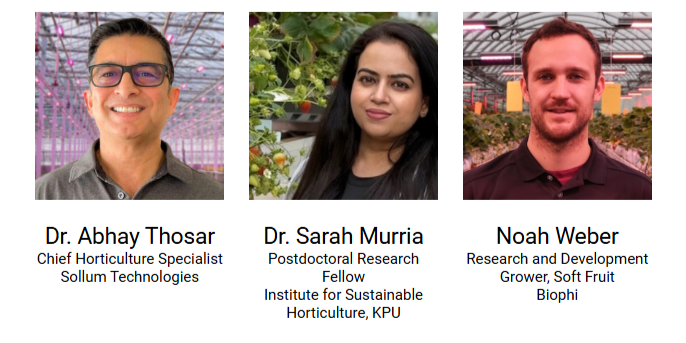
Source: Sollum Technologies webinar. Featured speakers who ran the trials.
West coast: KPU's Institute for Sustainable Horticulture (British Columbia). Dr. Sarah Murria is a postdoctoral research fellow at the Institute for Sustainable Horticulture (ISH) at Kwantlen Polytechnic University (KPU). A plant physiologist with a PhD from Punjab Agricultural University, her work centers on crop resilience, plant–pathogen interactions, and post-harvest quality. At ISH, she optimizes dynamic LED strategies in greenhouses. The research is supported by Mitacs and NSERC.
East coast: Biophi (Leamington, Ontario). Noah Weber is the research and development grower for soft fruit at Biophi, a research and development center in Leamington — the heart of Ontario's greenhouse belt. Biophi focuses on practical research from a grower's point of view: pushing crops and systems in ways that would be too risky in a commercial production house. Its trial ran in a working production greenhouse.
The West Coast: KPU tests timing, not just quantity
Dr. Murria's team set out to compare static and dynamic spectrum in greenhouse strawberries, test how different cultivars responded, and find recipes that adapt to changing greenhouse conditions.
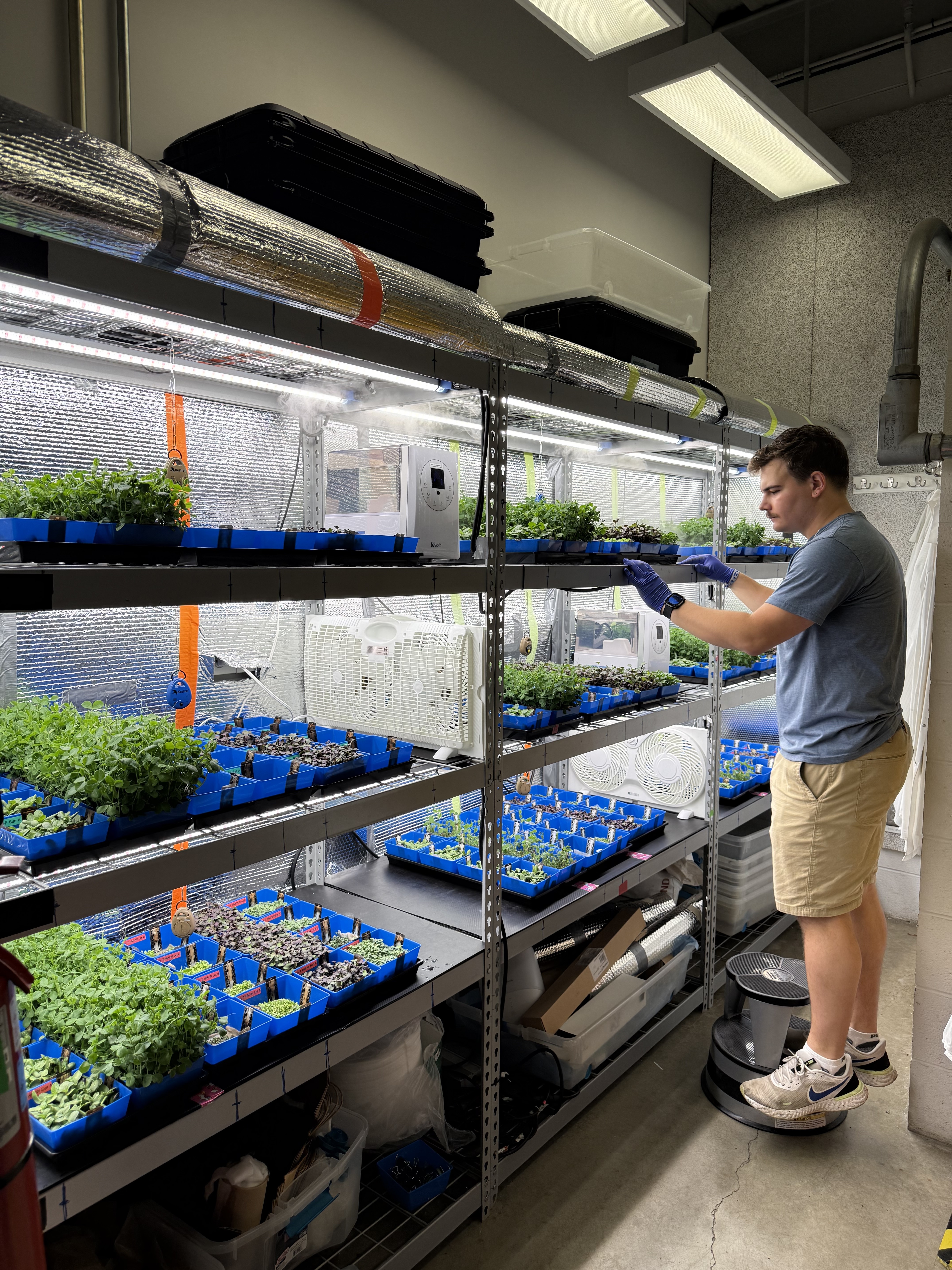
The KPU program runs for three years, from September 2024 to 2027, led by Dr. Li Ma as Principal Investigator, with Dr. Murria conducting the trials. Partners are KPU, Sollum, and Star Produce, supported by NSERC and Mitacs. The research greenhouse is 128 m² split into three zones by blackout curtains, each under its own Sollum lighting. Strawberries grow in coco coir at 8 plants per linear meter, at about 22/12 °C day/night and 60 percent relative humidity, with a DLI of about 20 moles per day. Seven cultivars are in the trials: Albion, Charlotte, Seascape, Lady Emma, Lady Isabella, Lady Grace, and Karima.

Source: Sollum. KPU case study headline results.
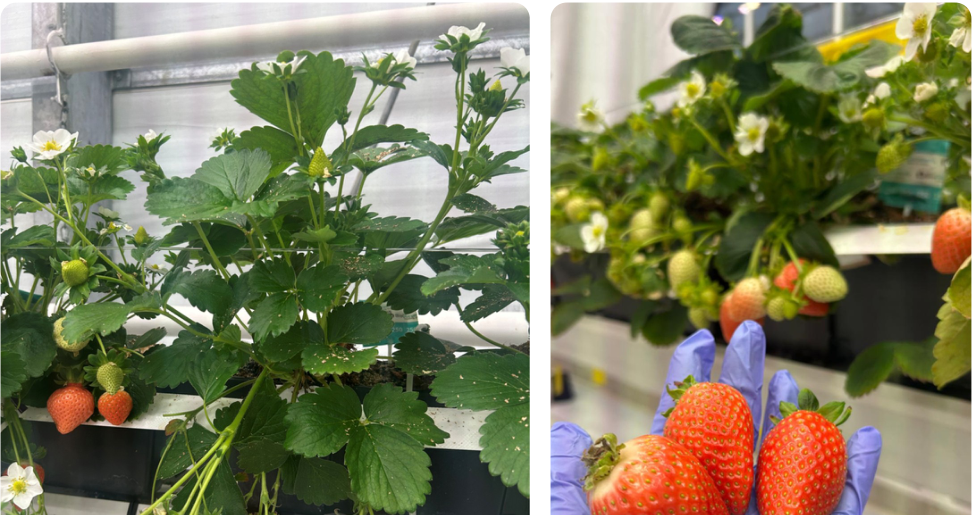
Source: Sollum. KPU case study: Plants, fruit, and the KPU research compartment.
Three strategies went head to head:
- Fixed LED spectrum (control).
- Dynamic LED spectrum, shifting through the day and across crop stages.
- Dynamic spectrum with night interruption.
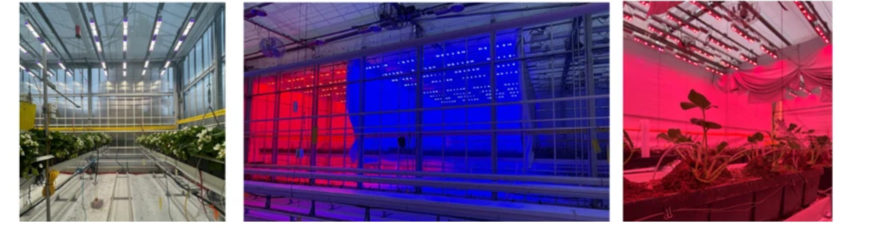
Source: KPU Institute for Sustainable Horticulture, Sollum webinar slide. KPU's three light strategies, funded by Mitacs and NSERC.
Does dynamic LED spectrum increase strawberry yield?
Depending on variety, dynamic spectrum delivered an 11.08% - 25.01% yield increase over static spectrum, with more stable production. The red-light treatment stood out: average fruit weight rose 20.22%, and yield per plant rose 58% versus the control.
Dr. Murria was careful about what that does not mean. The plants were not under red light all day. Red was delivered at specific times and blue at others. "The timing and the quality of light influence productivity," she said; it is not a case of simply adding more light.
Extending the broad-spectrum photoperiod from 14 to 16 hours raised yield per square meter by 22 percent for Seascape (0.98 to 1.19 kg/m²), 13 percent for Charlotte (1.37 to 1.55 kg/m²), and 40 percent for Albion (0.56 to 0.78 kg/m²). Managing the light dynamically to the 14-hour baseline also helped: +9 percent for Seascape, +12 percent for Charlotte, and +24 percent for Albion. Every lighting treatment increased yield in all three cultivars.
One caution from the researchers: these yields were measured over two months in a research greenhouse with wider gutter spacing, so full-cycle commercial yields would be much higher.
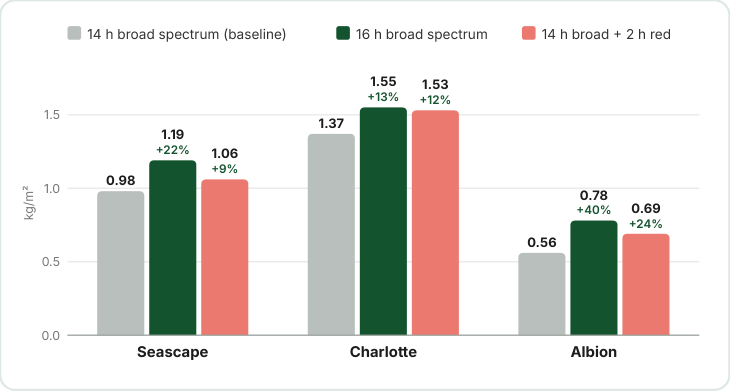
Source: Sollum. KPU case; research by Dr. Sarah Murria, KPU. Yield (kg/m²) by cultivar, spring 2025 photoperiod trial.
Plant growth and morphology
Every light treatment beat the fixed-spectrum control on plant height, stem growth, leaf area, and leaf number, so changing the spectrum made plants bigger overall. Red light produced the greatest leaf expansion: larger leaves, longer trusses and petioles, and significantly higher chlorophyll content. Longer trusses are more than cosmetic, since they separate flowers and fruit and make the crop easier to manage and harvest.

Source: Sollum. KPU case study, measuring starwberry under red light, where average fruit weight rose 20 percent.
Why blue light in the morning opens strawberry stomata
Blue light did something different: it increased ion flow, stomatal opening, and stomatal conductance compared with the other treatments. Scanning electron microscopy (SEM) confirmed it. Dr. Murria's team collected leaf tissue and applied the treatments in the early morning, just before sunrise. Under blue light, the stomatal pore was fully open; under red, it was slightly open; under the fixed spectrum, it was closed. Blue, in other words, wakes the plant up and prepares it for the day.
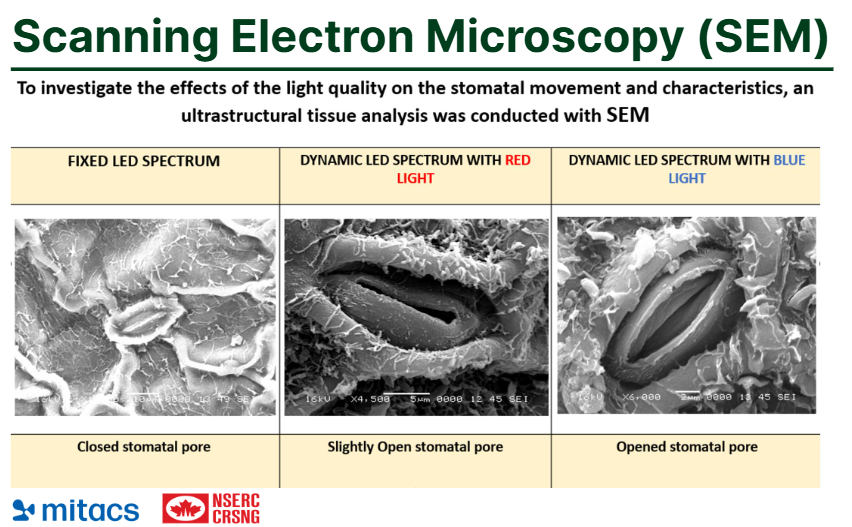
Figure 7. Stomata under fixed, red-dynamic, and blue-dynamic spectrum. Source: KPU / Sollum webinar slide.
How do red, blue and far-red light change strawberry fruit quality?
Under blue (or cool white) light, fruit sweetness rose 29.31% over the control. Plants stayed compact but produced more flower clusters, with improved biomass accumulation, antioxidants, total phenols, and anthocyanins. Fruit showed a bright red color, ripened early, and had a longer shelf life.
Red light gave bigger and heavier fruit on longer trusses that are easier to harvest. Sweetness rose 25.65% over the control, and fruit had higher titratable acidity and lower pH, which also supports shelf life. Far-red light accelerated ripening and encouraged stem elongation, longer trusses and petioles, and a more open canopy architecture that improves airflow for disease management.
Anthocyanins and fruit color
Anthocyanins, the pigments behind red fruit color, were Dr. Murria's main biochemical focus. Both blue and red light increased anthocyanin accumulation in strawberry fruit, and both produced higher proanthocyanidin content than the control. Blue light stimulated the most, at 66.9% above control, which fits its link to early picking and longer shelf life. Red light raised anthocyanins by 32.3 to 45.5% while also delivering bigger, heavier fruit.
That points to a practical combination: a red-based spectrum for fruit size, with some blue at the right time of day to improve color and visual quality. The commercial relevance is better fruit color and appearance, though Dr. Murria stressed this is a short window of blue, not blue all day.
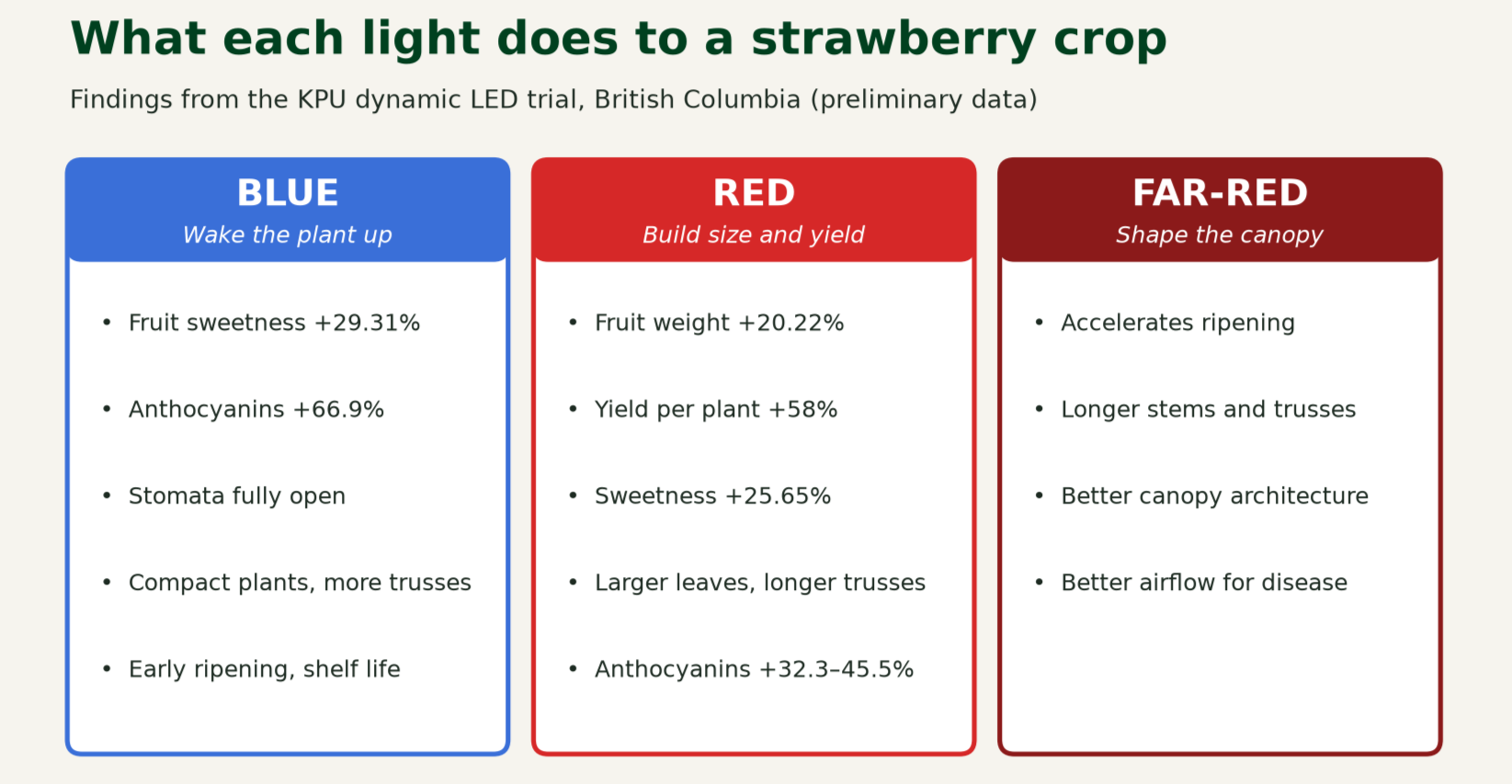
Sources: KPU & Sollum webinar slides. Spectrum cheat sheet.
The honest takeaway is that no single spectrum wins. Red gave bigger fruit; blue gave sweeter, redder fruit and faster pigment accumulation. Dr. Murria's advice: stop asking which spectrum is best and ask which spectrum delivers the response you want at which time of day.
Disease and plant activity
Far-red and red light lengthened trusses and petioles, which improved canopy airflow and reduced conditions favorable to fungal disease. In the night-interruption plots, red and blue night light reduced powdery mildew conidia release. Dr. Murria sees a future role for dynamic lighting inside integrated pest and disease management.
Plant-wearable biosensors from Vivent added a physiological layer. Dynamic LED improved light-use efficiency, red light produced fewer and shorter stress events, and blue light raised morning plant activity. Higher activity meant higher nutrient demand — plants recovered once irrigation was optimized.
“This trial is helping us investigate new strawberry varieties and lighting strategies that can support productive and economically viable winter production in Canada, while identifying approaches that can improve the return on investment for growers.” — Dr. Deborah Henderson, Director, Institute for Sustainable Horticulture, KPU
The East Coast: Biophi tests spectrum and pruning
Weber's trial in Leamington ran from August 5, 2025 to June 1, 2026 — 43 weeks of production, deliberately targeting winter, when natural light cannot mask the effect of the spectrum. Two varieties, Albion (University of California, Davis) and Florice (Flevo Berry, Netherlands), were planted at 10 plants per linear meter on a double-gutter system. Two spectrum strategies crossed with two pruning strategies across two varieties made eight treatment groups in 400 square meters.
The Biophi Horticulture Innovation Hub partnered with Sollum to test whether supplemental lighting could make winter strawberries productive enough to capture strong winter prices, and how much a controllable spectrum could add as a research and crop-development tool. The trial ran in a poly greenhouse on a double-gutter system, with plants in coco at 10 plants per linear meter. The target DLI was raised from 18 to 20 moles per day during the season to support fruit load.

Source: Sollum & Biophi case study. Biophi trial at a glance.
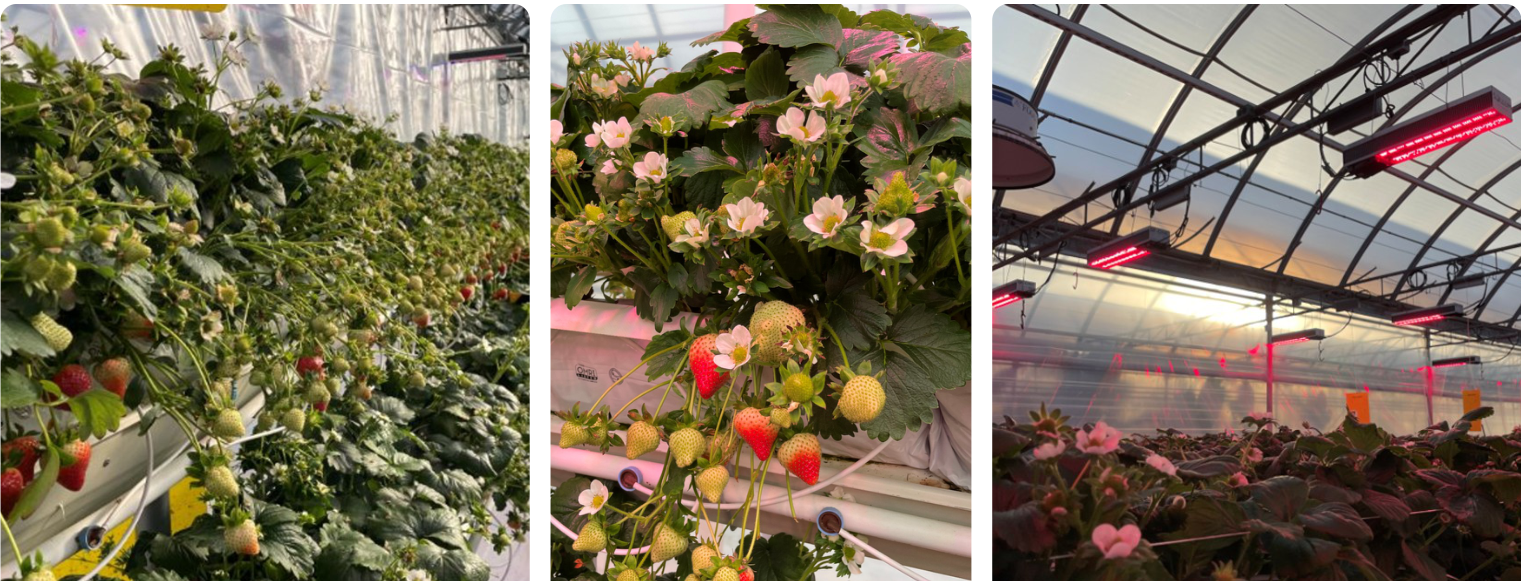
Source: Sollum & Biophi case study. Crop development under Sollum lighting at Biophi.
Spectrum. The control was a "balanced" spectrum of 68–74% red, 8–14% green, 8–14% blue, and 5–10% far-red. The flexible strategy of the spectrum was deployed to change the spectrum throughout the day, as well as dynamic dimming. Maximum intensity was 395–422 µmol/m²/s, with a daily light integral (DLI) target of 18–20 moles.
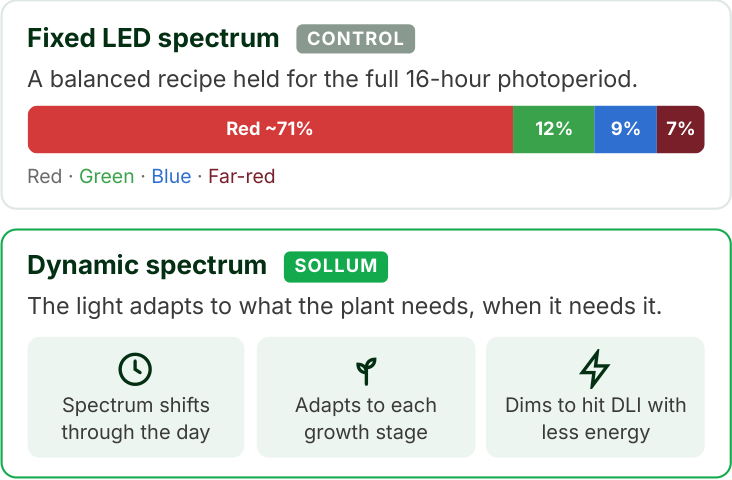
Source: Sollum & Biophi case study. Fixed versus dynamic spectrum at Biophi.
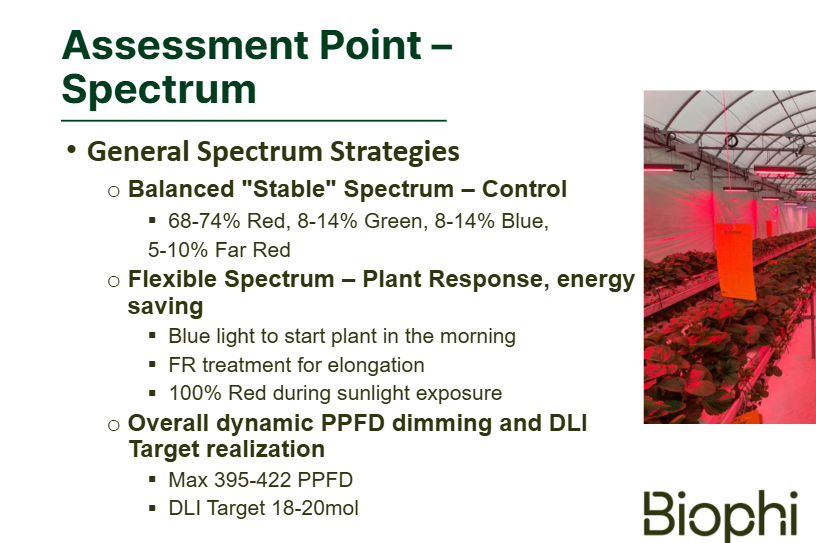
Source: Biophi & Sollum webinar slide. Biophi's stable and flexible spectrum strategies.
Pruning. Weber's team pruned flowers, not whole trusses — labor-intensive, but aimed at fruit size, not just volume. Static pruning held four flowers per truss. Flexible pruning adjusted to fruit load, guided by weekly plant registration and a target of 400 to 555 grams per square meter per week.
Results
Albion averaged 16.5 kg/m² and Florice 18.5 kg/m². The best group, Florice under flexible spectrum with static pruning, reached 22 kg/m². The crop averaged 4.4 kg/m² by December 31 and 8.4 kg/m² by Valentine's Day — the two windows that pay.
- Spectrum: flexible beat stable by 6–17%.
- Pruning: static beat flexible by 11–14%, which surprised the team.
- Fruit quality: pruning to fewer fruits per truss protected average fruit weight and king-fruit size.
The team tracked plant load per square meter week by week for Florice and Albion, which is how they spotted fruit-load swings and decided when to push light or prune harder. They also relied on automated dynamic dimming and DLI targeting through the Sollum dashboard.
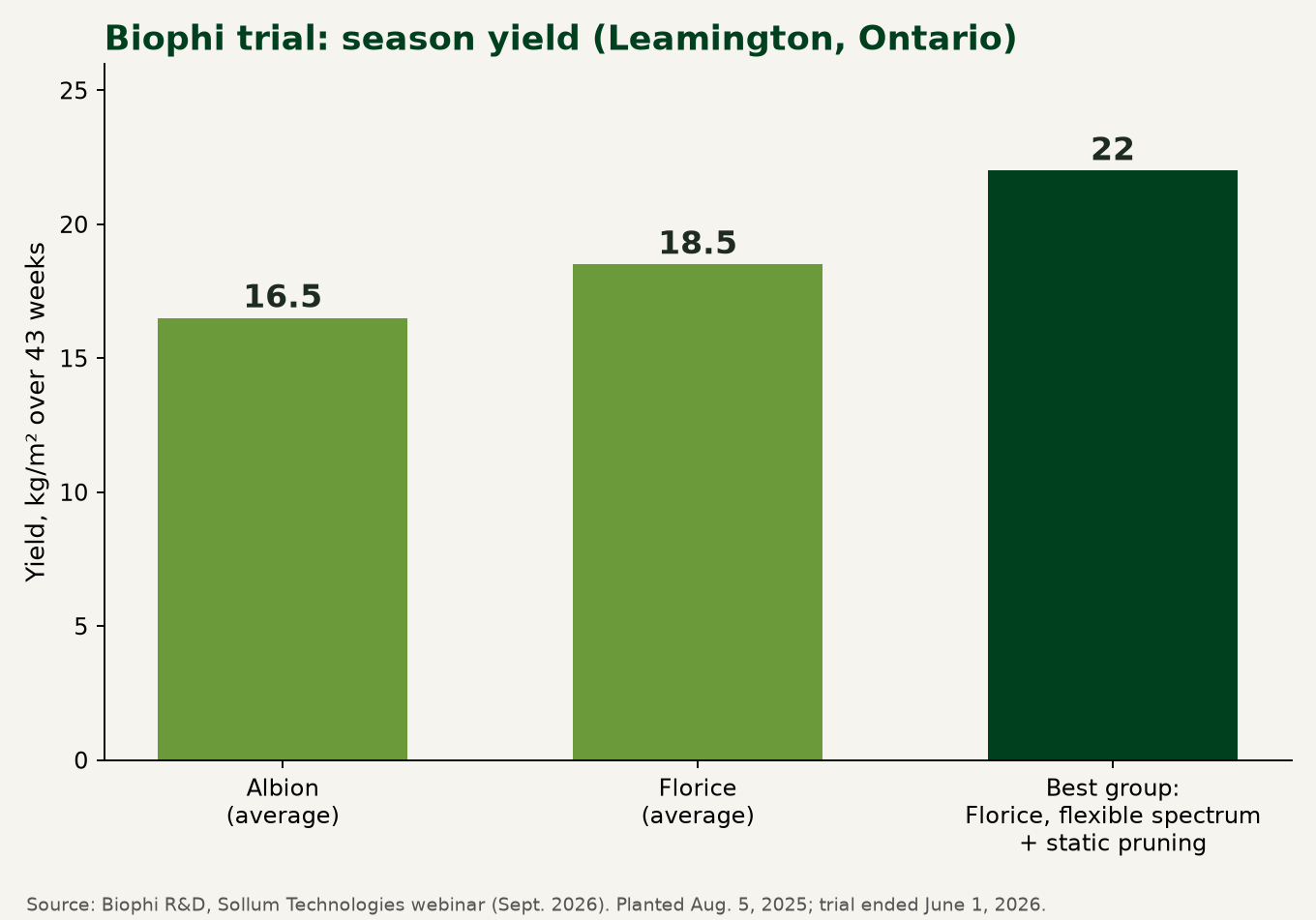
Source: Biophi & Sollum webinar, September 2026. Biophi trial results.
Spectrum is the finer point
Weber was candid that spectrum only works once the basics are right. Temperature, irrigation, fertilizer, CO₂, and humidity all have to tell the plant the same story. Wrong temperature, and spectrum hardly matters. Albion and Florice behaved differently throughout; at one point one section was flowering heavily while the other was quiet. When Albion began showing abortive flowers — a sign the plant could not carry more fruit — the team added light and temperature and pruned harder.
His next steps: proactive instead of reactive growing, fruit-load management, and treating dynamic spectrum as a steering tool alongside climate and irrigation.
“It definitely shows that it can be done and done well. The yield potential is there, and we can probably push strawberries to even greater yields as we understand them better and fine-tune the details to get those extra kilos.” — Noah Weber, R&D Grower, Soft Fruit, Biophi
Thinking about dynamic lighting for your strawberry crop? The right recipe depends on your cultivar, climate, and production targets. Talk to Sollum Technologies about a strategy built around your greenhouse.
What the two trials agree on
The shared conclusions are worth stating plainly, because they cut against how lighting is often sold.
- Dynamic beats fixed, with caveats. Both trials showed gains from changing spectrum over the day and crop cycle.
- Cultivar decides. The same recipe produced different results in different genetics. Treat any recipe from Europe or another coast as a starting hypothesis.
- Synchronize the environment. Light, climate, irrigation, and fertigation must be tuned together.
- Start with the grower's objective. Christmas and Valentine's Day volume, fruit size, color, shelf life, and electricity cost each point to a different recipe.
- Targets are moving. Both trials ran around 400 µmol/m²/s and 18 to 20 moles — above the old rules of thumb for strawberries. Dr. Thosar reported light-use efficiency typically between 3.25 and 4 grams per mole.
Build your lighting strategy with Sollum
The closing advice is simple: evaluate your own lighting requirements based on your greenhouse, environmental limitations, cultivar, and grower objectives. A recipe that works in Europe, or on the other coast, is a reference, not a plan.
If you want to see how four-channel dynamic LED lighting performs with your cultivars, in your greenhouse, contact Sollum Technologies to discuss a lighting strategy built around your crop and your production targets: sollumtechnologies.com.
Frequently Asked Questions
Older guidance was about 14 to 15 mol/m²/day. Both trials here targeted 18 to 20, and Sollum has seen responsive cultivars use up to 22. Ohio State's controlled-environment program puts the optimum at 20 to 25 and notes stress above 30. The right target depends on cultivar and fruit load.
Does dynamic LED spectrum increase strawberry yield?In these trials, yes. At KPU, dynamic spectrum raised yield 11 to 25% over fixed spectrum, depending on cultivar. At Biophi, flexible spectrum beat stable spectrum by 6 to 17% over a 43-week winter season, and the best group reached 22 kg/m².
What do red and blue light do to strawberries?At KPU, red light raised average fruit weight about 20% and lengthened trusses. Blue or cool white light raised sweetness 29% and anthocyanins 67%, and opened stomata before sunrise. Far-red sped ripening and opened the canopy for better airflow.
What is dynamic LED lighting?Dynamic LED lighting changes spectrum, intensity and timing through the day and across crop stages instead of holding one fixed recipe. Sollum's four-channel fixtures adjust to the crop, cultivar, natural sunlight and grower objectives, and dim automatically to hit a DLI target.
Will a lighting recipe from another greenhouse work in mine?Treat it as a starting hypothesis. Both trials found that cultivar, climate, irrigation and fertigation change how plants respond to the same spectrum. Biophi found spectrum matters only once temperature and the other basics are right.
- Sollum Technologies. (2026, September). Dynamic LED lighting for greenhouse strawberries [Webinar with Kwantlen Polytechnic University and Biophi]. Watch the webinar
- Kwantlen Polytechnic University. Institute for Sustainable Horticulture. kpu.ca/ish
- Biophi. biophi.ca
- Statistics Canada. Berry long time series: 100 years of strawberry statistics. statcan.gc.ca
- Sollum Technologies. sollumtechnologies.com
- Mitacs. mitacs.ca
- Natural Sciences and Engineering Research Council of Canada (NSERC). NSERC Alliance–Mitacs Accelerate grants. nserc-crsng.canada.ca
- HortiDaily. Automated real-time stress alerts from your plants increase yields (Vivent). hortidaily.com
- U.S. Plant Patent USPP34684 (Florice strawberry). Google Patents
- PR Newswire. The Center for Horticultural Innovation puts Sollum to the test. prnewswire.com




.png)
