

.jpeg)
.png)
BAYFIELD COUNTY, Wis. – As a child of the farm, I think of livestock, barns and green fields when I picture Wisconsin.
But our unique state is not just America’s Dairyland. We have one of the world’s mightiest rivers – the Mississippi – on most of the west coast, and two of the three largest Great Lakes on the east coast – Lake Michigan – and part of the north coast with Lake Superior. For those who grew up or live near a harbor town, water and those who work on it become your world.
A recent trip to the north shore along Lake Superior was a good reminder of that, highlighted by a visit to two of the Apostle Island lighthouses near Bayfield, Wisconsin – Michigan and Raspberry.
There’s something romantic and nostalgic about lighthouses and the stories of the men – and women – who worked and lived there. Those are remote windswept islands with a lonely lightkeeper working long hours night and day to keep the beacon burning to protect the hard-working sailors and their ships from the nautical hazards.
Of course the reality is far different. Yes, it was hard work and certainly isolated, but in those lighthouses the job was seasonal. The lake freezes in the winter and halts shipping, so there was no need for long, lonely winters keeping the light burning.
Michigan Island Lighthouse
Our first visit was to Michigan Island, which is a small island located about 16 miles from Bayfield. The island is unique with its two light towers. According to the National Park Service, the first light and attached lighthouse began operating in the spring of 1857 – but was shut down a year later. Apparently the light had been intended for service at Long Island but was built instead at Michigan Island.
A new lighthouse was built on Long Island while the Michigan Island light stood dark and empty for 10 years. But it received new life in 1869 when it was decided that a lighthouse was needed on the island after all. The stone building with stuccoed walls and a keeper’s dwelling was repaired and a light was installed.
Roswell Pendergast, one of the keepers who was stationed on the island from 1869 to 1874, planted different varieties of apple, cherry, peach, plum and pear trees, which he sold to supplement his income. That era is replicated with similar trees that have been planted recently and the grounds are well-kept with beautiful flowers.
Even though the light stands on top of a cliff, ships passing to the north of Michigan Island were unable to see the beacon. So efforts were started in 1908 to raise funds to erect a taller lighthouse. That came from the discontinued operation of the Schooner’s Ledge Light located on the Delaware River near Philadelphia. The cylindrical steel tower – built in 1880 – was disassembled and transported to Michigan Island, where it sat for 10 years before being installed in 1929. And other improvements were made to the island, including an electric generator, a radio fog beacon, a tramway that ran from the beach to the top and a new keeper’s dwelling.
At 112 feet, it’s the tallest lighthouse in Wisconsin. With its new electric-powered 24,000-candlepower lamp, the beacon was seen 22 miles across the lake. The light was automated in 1943. Currently the original Fresnel lens is on display at the Apostle Islands National Lakeshore Visitor Center in Bayfield. A modern lens sits in the tower.
I climbed the 138 steps – the equivalent of 11 stories – to the top without resting. It was a good workout for my bionic hips. I was a little out of breath, but the view was breathtaking. I did notice at the foot of the stairs there was a defibrillator – just in case.
Raspberry Island Lighthouse
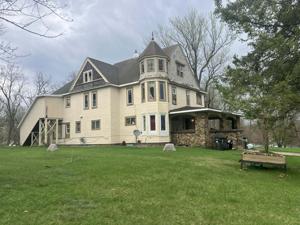
The Raspberry Island Lighthouse is located on the southern part of Raspberry Island, on the western channel of Lake Superior, 14 miles from Bayfield. It’s a picturesque wood-framed lighthouse that consists of a square tower attached to the lighthouse keeper’s quarters. Other buildings include a former fog-signal building, boathouse, barn and former oil house.
According to the National Park Service, Bayfield founder Henry Rice urged the construction of the light to help show the way to his new port. The lighthouse was built in 1862 but the Fresnel lens that was built in France was not put into place until 1863.
For the first few years there was only one keeper assigned to the station. Francis Jacker was a keeper in the 1880s and lived there alone, leaving his family on his farm. He noted the danger of having only one keeper in his log.
“Proper surveillance of the revolving apparatus during the long nights of the fall when frequent windings are required, is exhausting,” he wrote. “In case of an emergency, no assistance is available on the island.”
Jacker’s words were prophetic; in September 1887 a storm blew in. Jacker tried to move the station’s small boat to a sheltered spot during the storm but was blown off course and shipwrecked on Oak Island. He spent three days on the island before being found by a search party organized by his wife, who had decided to pay her husband a visit and realized he was missing.
Jacker’s experience resulted in the establishment of an assistant keeper. A third position was added as shipping traffic became heavier and when a fog signal building was added in 1903.
A new building was constructed around the light tower in 1906 to house the additional staff. It was occupied until 1947, when the light was automated. A new lens was installed on a battery-mounted pole in front of the lighthouse in 1957 and the original lens was removed for display at the Wisconsin State Historical Society Museum on Madeline Island.
Visitors are allowed to tour the house and the grounds, and climb the steps to the top of the light tower.
The Apostle Islands Cruise Service operates seasonal boat trips to visit the islands, which can also be reached by water taxis or private boats. There is an additional fee charged for tours by National Park Service staff and volunteers.
The Apostle Islands National Lakeshore features 21 islands and shoreline that are part of the ancestral homeland of the Ojibwe people. The area is located at the northern tip of Wisconsin’s Bayfield Peninsula. The national park was established in 1970. There are 10 active or former lighthouses located within the islands. Visit bayfield.org/apostle-islands/lighthouses for more information.

Chris Hardie
This is an original article written for Agri-View, a Lee Enterprises agricultural publication based in Madison, Wisconsin. Visit AgriView.com for more information.
Chris Hardie and his wife, Sherry, live on his great-grandparents’ Jackson County farm. Nominated for a Pulitzer Prize in 2001, he is a former member of the Wisconsin Freedom of Information Council and past president of the Wisconsin Newspaper Association. His book “Back Home: Country Tales by the Seasons” is available through Amazon.
Be the first to know
Get local news delivered to your inbox!








.png)
