

.jpeg)
.png)
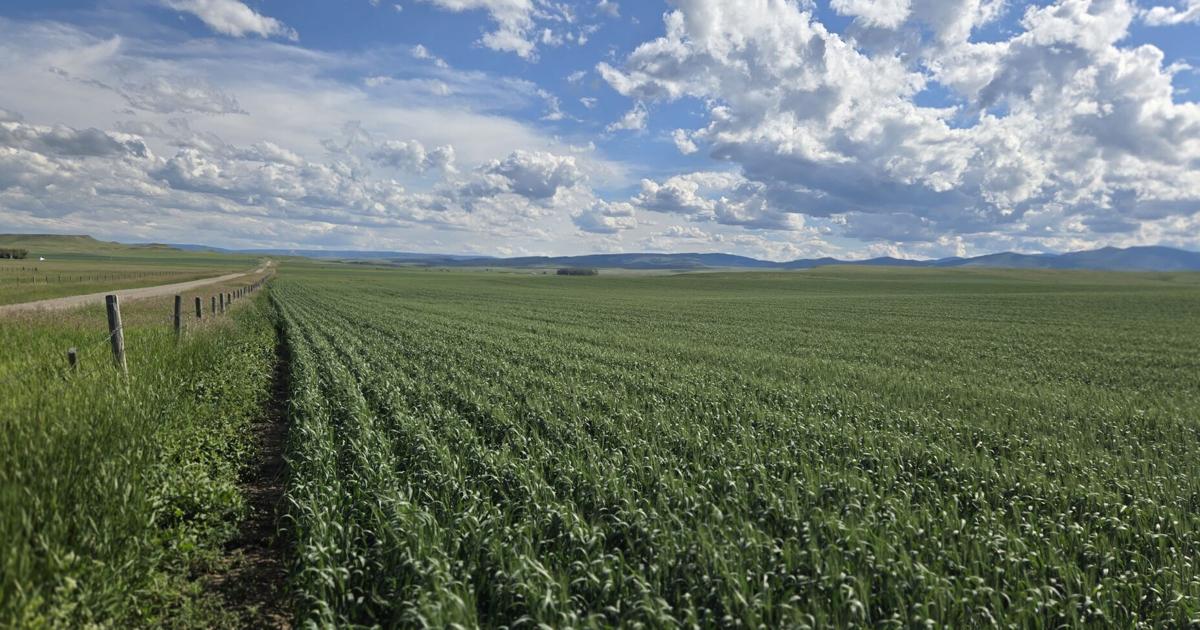
Montana farmers produce some of the highest quality hard red spring wheat and hard red winter wheat in the country, but pests, such as the wheat stem sawfly, continue to damage wheat and cut into their bottom lines every year, especially in the Golden Triangle.
In 2024 alone, the Montana Wheat and Barley Committee estimated statewide losses from the sawfly for wheat were $66 million, with yield losses up to 45 percent on individual farms.
“The wheat stem sawfly is the most serious insect pest of spring wheat and durum in Montana. We’re trying to find practical solutions to manage the wheat stem sawfly, including an early detection program through the use of drones,” said Tiziana Oppedisano, Montana State University (MSU) entomology specialist, who spoke this summer at field days in Williston, N.D.
Research on the pest is currently focused on two unique projects demonstrating different ways the sawfly could be managed in the future.
One project is based on the fact that the sawfly is attracted to some wheat odors from certain varieties at different growth stages of the plant and is not attracted to or repelled by other odors released from other wheat varieties.
They used spring wheat plants for the project, but in the future, they’ll use durum, as well.
Oppedisano and others analyzed volatile organic compounds (plant odors) at different growth stages of spring wheat to see if certain wheat varieties emitted chemicals that repelled sawflies and others that attracted sawflies.
“Spring wheat and other plants release odors called volatile organic compounds (VOCs), and the sawfly, as well as other insects, use these smells to locate plants for laying eggs and feeding,” Oppedisano said.
Researchers are aware that female sawflies likely avoid laying eggs on plants that are already infested, and they may smell certain odors to know that stem is infested.
“Why would a female lay eggs on a spring wheat plant that has already been infested and might not leave room for your larvae to survive?” Oppedisano said.
She said they know that only one larva survives in each wheat stem.
“We know sawflies are cannibalistic, meaning that when the eggs start emerging, the larvae feed on each other and only one larva survives per stem,” she added.
They started collecting the VOCs, which were trapped in filters, and identified using a gas chromatography mass spectrometry.
“We are identifying compounds that attract or repel the wheat stem sawfly, and in the future, we hope to use attractants to lure the sawfly into traps to monitor the pest and develop forecasting models,” she said.
They found that certain varieties, such as Vida, can emit odors that are attractive to the sawfly in the early stages of growth when plants are most susceptible to oviposition, and other varieties that were less attractive.
“Preliminary results showed that Vida emitted significantly higher levels of a sweet, floral compound called linalool, a flowery lavender scent, at early growth stages, and had more infestations of the sawfly compared to Dagmar, which was less attractive to sawfly,” she said. .
Repellents could be used in the future as a foliar application to deter the sawfly from crops. But the project is not at the point yet where they know all the varieties that emit attractive odors and all the varieties that emit repellent odors in the early growth stages.
“We are keeping this collection of odors and chemical compounds, and hopefully we will have more results next year. So, we are planning to include more varieties and do more of this work in not only spring wheat, but winter wheat, as well,” she said. “It’s already encouraging to see the results. That might give a little explanation to the different infestation rates that we see in the field.”
In the second research project, remote sensing technologies, such as drones with advanced cameras, were used to detect subtle changes in plant reflectance not visible to the naked eye, according to Oppedisano.
“What we think is that the larvae feeding inside the plants can cause physiological stress that we cannot actually see with our naked eyes until is too late in the season and we see the damage and the lodging that they cause in the field,” she said.
The sawfly has been especially difficult to find a solution for because of the fact the larvae are hidden inside the stem and do a lot of damage that isn’t noticed until the stem is cut. By that time, it is too late to remedy the damage, except for swathing the crop at harvest.
That is where drones come in. Drones equipped with hyperspectral cameras could be used to detect early physiological stress in wheat caused by sawfly larvae.
“Hyperspectral cameras have the most sophisticated sensors that we can put on a drone. These sensors are able to identify differences in reflectance of light in plants with different physiological stress. So, they can see if there is maybe abiotic stress of any type, but in our case, the presence of the larvae sawfly inside the plant,” she said. “What we are trying to develop here is a system for an early detection of sawfly in the field.”
The researchers used six spring wheat varieties: Lanning, MT Ubet, Vida, Dagmar, MT Carlson and Choteau, in their initial drone project conducted last year at the Western Triangle Ag Research Center in Conrad, Mont. Reflectance was measured using the special camera mounted to an Aurelia X8 Max drone.
Preliminary results showed semi-solid Vida and Dagmar performed better in terms of grain quality and yield, and solid and semi-solid varieties had higher resistance to the sawfly.
“MSU has started a huge program in precision agriculture, and we have hired – in the last two years – several different faculty members specializing in different sectors of precision ag. One of these is faculty who use the application of drones and satellites to investigate insects, such as the wheat stem sawfly,” Oppedisano said.
This year, the researchers are conducting a sawfly field trial with drones and 18 varieties of spring wheat and 18 varieties of winter wheat.
“It is a huge collection, and we are very excited about the data that we are collecting,” she said.
Several researchers are involved in the project, in addition to Oppedisano, including David Weaver, who has been working on the wheat stem sawfly management for decades.
Be the first to know
Get local news delivered to your inbox!




.png)
