
 1 hour ago
4
1 hour ago
4

.jpeg)
.png)
Press play to listen to this article
Voice
Eggs are one of the most widely consumed animal products in the world. Almost everyone has eaten an egg, but very few people stop to think about how it is formed, what it contains, or why it matters beyond the breakfast table. Understanding egg formation gives you a clearer picture of poultry farming, food quality, and nutrition all at once.
An egg is an oval or round object laid by a female bird, reptile, fish, or invertebrate. It usually contains a developing embryo, which it supports and sustains. In simple terms, it is a reproductive cell that helps increase the number of animal species.
Eggs are produced by different types of poultry, including chickens, turkeys, ducks, guinea fowl, and quail. Chicken eggs are the most commonly eaten. Hens lay both fertilized and unfertilized eggs. Fertilized eggs can develop into chicks and hatch after 21 days. Unfertilized eggs, often called table eggs, contain no embryo and are what most people eat daily.
In general, an egg is made up of several parts: a hard outer shell, albumen (the white), and the yolk. There are also thin membranes on the inside of the shell. By weight, an egg is roughly 30 to 33% yolk, about 60% albumen, and 9 to 12% shell. In developed countries, eggs are sorted by size, from small to extra-large. In many developing countries, no formal grading system is applied, and eggs are sold based on general appearance.
Eggs are also considered one of the best natural food sources for humans. They provide a wide range of nutrients and are used both at home and in food industries. This article covers how an egg is formed, how eggs are produced commercially, and what egg quality means.
Read Also: Factors Affecting Hatchability of Poultry Eggs
🌿 Go Organic on Your Farm: Instead of harmful chemical pesticides and fertilisers, try our organic farming products — including neem oil spray, bio-pesticides, natural plant treatments, organic seeds and seedlings, suckers, and many more organic products that are safe for your health, your family, your soil and your harvest. Shop Now →
Egg Formation and Production Process

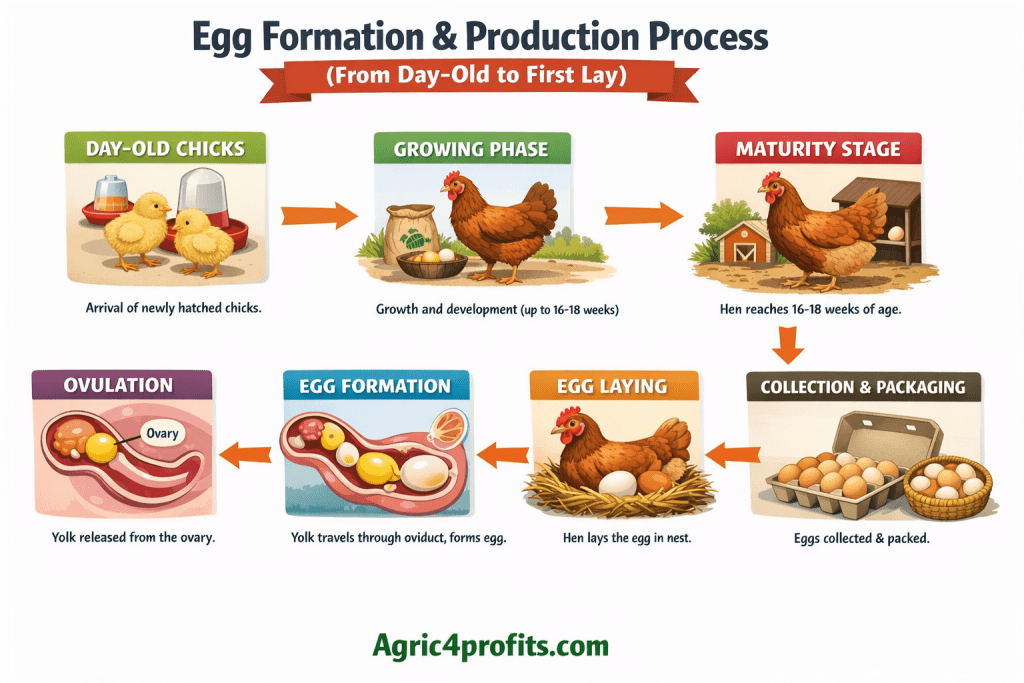
The egg is formed through the hen's reproductive system. The entire process, from ovulation to laying, takes just over 24 hours. Understanding this process helps farmers manage their flocks better and improve egg output.
Ovulation is the release of an ovum (an unfertilized yolk) from a ruptured follicle in the ovary. The ovum then drops into a section of the reproductive tract called the infundibulum. Ovulation usually happens about 30 minutes after the previous egg has been laid.
If the hen has mated with a rooster, fertilization happens in the infundibulum, which can store sperm for 7 to 14 days. After fertilization (or without it, for table eggs), the egg continues its journey through the oviduct, picking up its various layers along the way.
Although hens develop two sets of ovaries and oviducts during embryonic growth, only the left set fully develops. The mature ovary contains several follicles at different stages of development at any given time. The largest follicle is the one ovulated to form an egg. The ovary typically produces one mature yolk every 24 hours.
🔧 Free Farm Tool Available: Use our free Agric4Profits Farm Tools to calculate your farm profits, formulate feeds, identify pests and diseases on both your crops and animal farms, plan your planting and harvesting season, including many more farm tasks to get free expert advice and recommendations — completely free, no registration required. Access Free Tools →
1. Journey Through the Oviduct

The oviduct is the channel through which the developing egg travels from the ovary to the outside. It has several sections, each adding a different part of the egg.
i. Infundibulum: The ovum enters here first. The chalazae and the membrane surrounding the yolk (perivitelline membrane) are formed in this section. The yolk spends about 15 minutes here before moving on.
ii. Magnum: This is the longest part of the oviduct. The albumen (egg white) is deposited here. The yolk takes 2 to 3 hours to pass through the magnum. The albumen serves several purposes: it feeds a developing embryo, protects the yolk from physical damage, fights bacteria, and supports the formation of shell membranes.
iii. Isthmus: The inner and outer shell membranes are formed here. This stage takes about 1.5 hours.
iv. Shell Gland (Uterus): The developing egg spends 18 to 21 hours here. During this time, the albumen absorbs water and electrolytes through a process called "plumping." The shell, made up of about 95% calcium carbonate and 5% organic material, is also formed here. This stage is when the hen's calcium needs are at their highest. Once the shell is complete, a protective coating called the cuticle is applied over it.
💬 Have a Farming Question? Join thousands of farmers across Africa on the Agric4Profits Community — ask questions, share experiences and connect with agricultural experts. It is completely free. Ask Your Question Now →
v. Vagina and Cloaca: The egg is pushed out large end first by hormonal contractions. Even though the egg travels through the oviduct small end first, it exits the hen large end first during laying (oviposition).
Read Also: Causes of Egg Production Reduction in Poultry Farms and Ways to Prevent Them
2. Egg Production
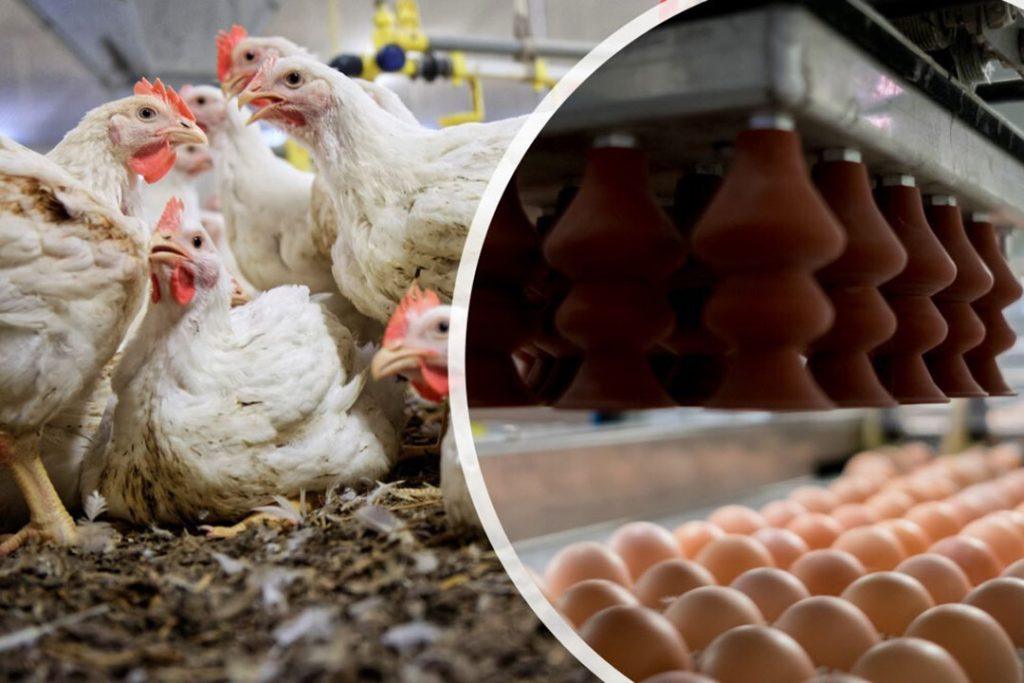
Eggs are produced commercially by a specialized breed of chicken called layers. These birds come from parent stock called breeders. Fertilized eggs from breeders are hatched in machines called incubators, which automatically control temperature and humidity. The chicks hatch after 21 days and are called pullets.
Pullets are raised in poultry houses for about five months before they begin laying. Since it takes roughly 24 hours to form one egg, a healthy hen should ideally lay one egg per day. In practice, about 70 to 80% of a flock lay daily, since birds do not all start laying at the same time.
Egg production peaks around three months after a hen starts laying and stays near that level for about nine months before gradually declining. Some farmers extend this cycle to 12, 18, or even 24 months using a management technique called molting. This involves restricting the hen's diet to make it lose feathers and rest temporarily. After molting, the hen resumes laying, though not at her earlier peak rate.
Read Also: How to Select the Best Quality Egg Laying Chickens at Point of Lay (P.O.L)
3. Egg Quality

Egg quality refers to all the features of an egg that determine its value. It matters to producers, traders, and consumers alike. Poor-quality eggs are rejected or sold at lower prices, which affects profitability across the supply chain.
In many developing countries, formal egg grading is not common. But even without a grading system, consumers will avoid eggs with misshapen shells, watery albumen, or spotted yolks. In contrast, developed countries like the United States use grading systems. The USDA, for example, grades eggs as AA, A, or B in decreasing order of quality, and eggs are sold with labels showing their grade.
Egg quality is evaluated using two main methods:
📖 Want to Go Deeper on This Topic?
Our expert agricultural ebooks cover poultry, fish farming, different crops production, snail farming, organic farming, mushrooms, sheep, cattle, flowers, pig farming, goat farming, agribusiness, etc. in practical step-by-step detail — written by agricultural professionals for African farmers.
1. External Quality: refers to the shell's appearance, cleanliness, and strength. The shell is the first line of defense against bacteria, so a clean and intact shell is important. Shell quality is measured by breaking strength, shell thickness (measured with a micrometer gauge), and the shell's percentage of total egg weight. Shell thickness is considered the simplest and most reliable indicator of shell strength. The shell is made up of about 94% calcium carbonate and accounts for roughly 12% of a large egg's total weight.
2. Internal Quality: refers to the appearance and consistency of the egg's contents. This is assessed by breaking the egg onto a flat glass plate. Key measures include the albumen index, yolk index, Haugh units, and yolk color.
Albumen and Yolk Index = (Albumen or Yolk height in mm / Albumen or Yolk width in mm) x 100
The Haugh unit is one of the most widely used measures of internal egg quality. To get it, the egg is weighed and then broken onto a flat surface. A micrometer measures the height of the thick albumen around the yolk. The height and weight are used together to calculate the Haugh unit score. The higher the score, the fresher and better the egg.
Haugh Unit = 100 log10 (h - 1.7w0.37 + 7.6)
Where;
h = observed height of the albumen in millimeters, w = weight of egg in grams.
Haugh unit values range from 0 to 130. A score of 75 to 90 and above means the egg is of excellent quality. A score between 30 and 60 points indicates poor or very low quality. As eggs age, both the white and yolk break down, lowering the Haugh unit score.
Yolk color is measured using a color fan (a device with a range of yellow-to-orange shades) or a digital spectral machine. The color of the yolk is directly affected by what the hen eats. Feed rich in yellow, fat-soluble pigments, such as carotenes found in dark green plant material, tends to produce deeper yolk colors. But a richer color does not always mean better nutrition. Some pigments that deepen yolk color, like xanthophylls, have little nutritional value. A hen fed a diet rich in vitamin A but lacking those pigments can produce pale yolks that are just as nutritious.
Eggs remain one of the most portable and nutrient-rich foods available. The ability of a hen to lay one egg per day, when managed well, makes egg production a reliable source of high-quality food. This can play a meaningful role in addressing food shortages, especially in regions where access to protein is limited.
Read Also: Management Guide for Layers for Better Egg Production
Summary on Egg Formation and Production Process
| What is an Egg? | An oval or round object laid by female birds; contains a developing embryo or serves as a table egg |
| Types of Eggs | Fertilized eggs (develop into chicks after 21 days) and unfertilized eggs (table eggs) |
| Egg Composition | Yolk (30-33%), albumen (about 60%), shell (9-12%) |
| Egg Formation Duration | Just over 24 hours from ovulation to laying |
| Key Oviduct Stages | Infundibulum (15 min), Magnum (2-3 hrs), Isthmus (1.5 hrs), Shell Gland (18-21 hrs) |
| Egg Production | 70-80% of a flock lays daily; peaks 3 months after first lay |
| Molting | A technique used to extend laying cycles up to 24 months |
| External Egg Quality | Based on shell appearance, cleanliness, and strength |
| Internal Egg Quality | Measured by Haugh units, albumen index, yolk index, and yolk color |
| Haugh Unit Score | 75-90+ = excellent quality; 30-60 = poor quality |
| Yolk Color | Influenced by feed quality; does not always reflect nutritional value |
Frequently Asked Questions About Egg Formation and Production Process
1. How long does it take a hen to form one egg?
It takes just over 24 hours for a hen to form and lay one egg. Most of this time (18 to 21 hours) is spent in the shell gland where the shell is formed.
2. What is the difference between a fertilized and unfertilized egg?
A fertilized egg contains a sperm cell that has joined with the ovum and can develop into a chick. An unfertilized egg has no embryo and is safe to eat. These are commonly called table eggs.
3. What are the main parts of an egg?
An egg has three main parts: the shell (9-12%), the albumen or egg white (about 60%), and the yolk (30-33%). Inside the shell are also thin membranes that protect the contents.
4. What does the albumen do in a developing egg?
The albumen serves as a food source for the embryo, cushions the yolk against physical damage, fights bacteria, and helps support the formation of shell membranes.
5. When do hens start laying eggs?
Pullets (young female chickens) start laying at about five months of age. Egg production reaches its peak around three months after the first lay.
6. What is molting and why is it done?
Molting is a process where hens are made to lose feathers through dietary changes. It gives their reproductive system a rest. After molting, hens resume laying, which extends their productive life to 18 or 24 months.
7. What is a Haugh unit?
A Haugh unit is a measure of egg freshness and albumen quality. It is calculated using the height of the thick egg white and the egg's weight. Scores of 75 to 90 and above mean high quality. Scores below 60 indicate poor quality.
8. Does yolk color indicate egg quality?
Not always. Yolk color is mainly determined by the hen's diet. A deeper yellow or orange yolk comes from feed rich in certain pigments, but a pale yolk from a vitamin A-rich diet can be just as nutritious.
9. How are eggs graded for quality?
In countries like the United States, the USDA grades eggs as AA, A, or B. Grade AA is the highest quality. Grading looks at shell condition, albumen thickness, yolk shape, and overall appearance. Many developing countries do not use a formal grading system.
10. Why is the shell mostly calcium carbonate?
Calcium carbonate (about 94% of the shell) gives the shell its hardness and strength. It protects the egg contents from damage and bacterial contamination. This is why hens need enough calcium in their diet, especially during the shell formation stage.
Do you have any questions, suggestions, or contributions? If so, please feel free to use the comment box below to share your thoughts. We also encourage you to kindly share this information with others who might benefit from it. Since we can’t reach everyone at once, we truly appreciate your help in spreading the word. Thank you very much for your support and for sharing!
Read Also: Chicken Brooder House – Complete Chicks Brooding Care Guide








.png)
