
 3 hours ago
2

.jpeg)
.png)
Press play to listen to this article
Voice
Starting a tilapia farm from zero requires more than fish and water. You need clear planning, proper pond or tank design, reliable feed, and daily attention to water quality if you want steady profits.
Tilapia is attractive because it grows quickly, tolerates a wide range of environments, and can perform well in controlled systems. Even so, poor management can turn a promising venture into an expensive mistake.
Good results come from matching your production system to your budget, local climate, market demand, and technical skill. The right setup reduces losses, improves growth, and makes harvests more predictable.
This article explains the main steps, from choosing species and stocking systems to managing oxygen, pH, and feed. It also shows how to plan for profit without compromising fish health through the right pond blueprint.
A. How to Start a Tilapia Fish Farm
The first decision is species selection, because not every tilapia strain performs the same in every environment. Match the strain to temperature, salinity, market goals, and management capacity before you buy fingerlings.
Nile tilapia remains the most widely farmed choice because it grows fast and adapts well to ponds and tanks. Blue tilapia suits slightly cooler conditions, while GIFT lines can improve growth efficiency.
🌿 Go Organic on Your Farm: Instead of harmful chemical pesticides and fertilisers, try our organic farming products — including neem oil spray, bio-pesticides, natural plant treatments, organic seeds and seedlings, suckers, and many more organic products that are safe for your health, your family, your soil and your harvest. Shop Now →
Your production system should also match your resources. A pond, cage, raceway, or tank changes labor demands, stocking density, and feed response, so design should come before stocking and spending with production system.
If you are starting small, a backyard pond or compact tank system lets you learn daily routines before scaling up. That early practice often prevents avoidable losses and helps build confidence with starting small.
i. Climate fit: Choose a strain that matches local water temperature and seasonal changes, because poor climate fit slows growth, increases stress, and can create expensive losses before the first harvest.
ii. Market fit: Pick fish that buyers prefer in your area, since a strain that grows well but sells slowly can reduce profit, delay sales, and create storage pressure at harvest.
🔧 Free Farm Tool Available: Use our free Agric4Profits Farm Tools to calculate your farm profits, formulate feeds, identify pests and diseases on both your crops and animal farms, plan your planting and harvesting season, including many more farm tasks to get free expert advice and recommendations — completely free, no registration required. Access Free Tools →
iii. Hatchery quality: Buy from dependable hatcheries with healthy broodstock, because weak fingerlings often carry hidden problems that appear after stocking and weaken the entire crop within weeks and months.
Species choice should always connect to your sales plan. Live fish, smoked fish, and fillet markets may reward different sizes, growth rates, and body shapes, so start with demand, not guesswork through your sales plan.
| Tilapia type | Short description | Best use |
| Nile tilapia | Fast growth, strong adaptation, and broad market acceptance. | Warm freshwater ponds and tanks. |
| Blue tilapia | Good performance in slightly cooler water and stable conditions. | Mixed freshwater and mild brackish systems. |
| Mozambique tilapia | Hardy fish with moderate growth and lower cold tolerance. | Warm freshwater environments. |
| Andersonii | Known for good taste and smaller body size. | Cooler-water culture. |
| Abbassa and Akosombo | Hybrid strains bred for faster growth. | Commercial tilapia production. |
| Rendalli | Largely herbivorous and useful in integrated systems. | Aquaponics and plant-linked culture. |
| Monosex tilapia | All-male crop for more even growth and fewer fry. | Intensive and semi-intensive farms. |
| GIFT | Improved line with stronger growth and survival traits. | Commercial farms seeking higher output. |
Read Also: Feeding Methods for a Small Tilapia Fish Farm
B. Everything You Need to Know to Grow Tilapia
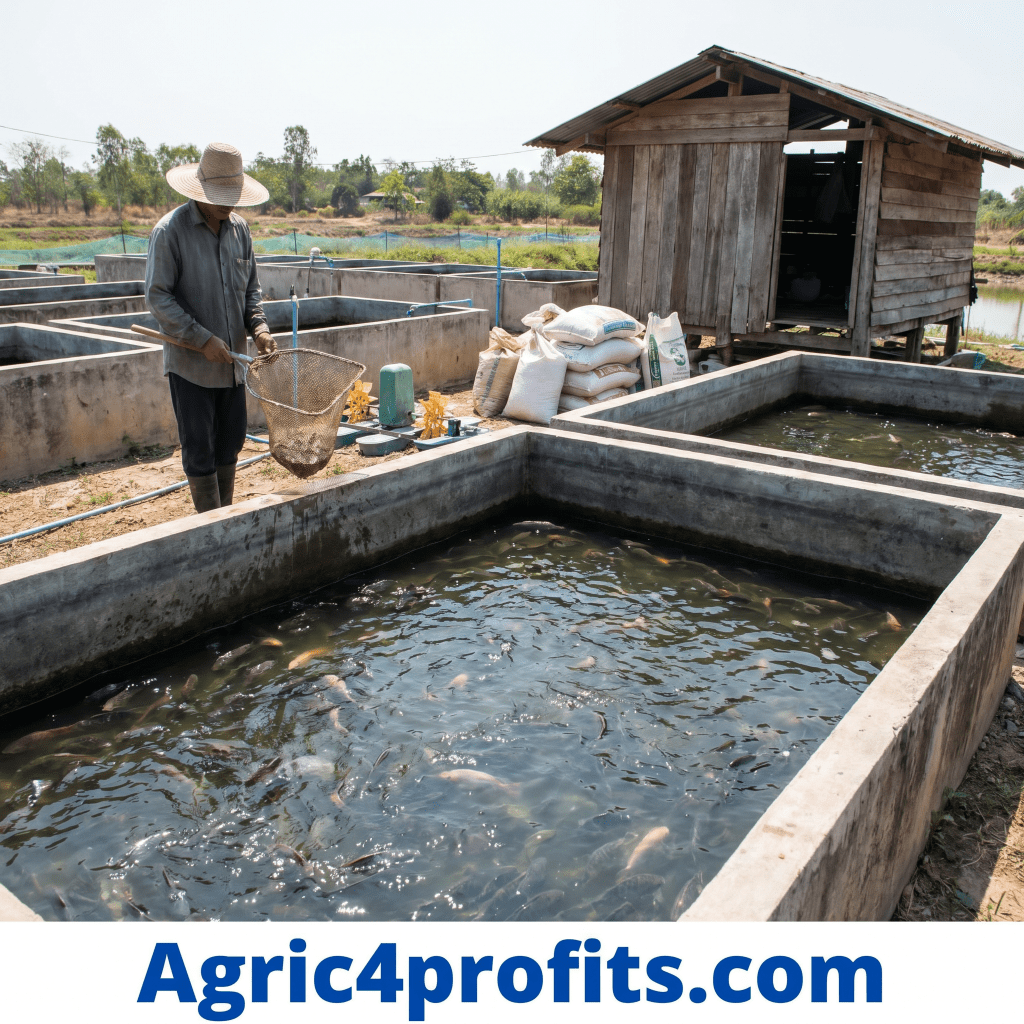
Learning the basics early gives you a much better chance of success. Tilapia is native to Africa, but only certain strains are practical for commercial culture because they combine fast growth, resilience, and market acceptance.
Before stocking, understand how feed, stocking density, temperature, and aeration affect the fish every day. These factors interact constantly, and weak control in one area usually slows growth elsewhere through practice.
💬 Have a Farming Question? Join thousands of farmers across Africa on the Agric4Profits Community — ask questions, share experiences and connect with agricultural experts. It is completely free. Ask Your Question Now →
One common mistake is overcrowding. Too many fingerlings may look profitable at first, but density pressure increases stress, waste, and disease risk. A controlled stocking plan protects performance and simplifies feeding.
ii. Breeding pressure: Female tilapia can spawn repeatedly, and uncontrolled reproduction creates too many small fish in the system. Monosex production helps limit overpopulation and keeps growth more uniform overall.
iii. Feed quality: Poor rations slow growth, increase waste, and reduce profit. Use feeds that match fish size and stage, because size-based nutrition improves conversion and reduces unnecessary expense significantly.
iv. Sales timing: Some farmers wait too long to harvest, while others sell too early. Proper harvest timing protects size uniformity and helps you reach the market window where buyers pay better prices.
Feed management should always follow fish size and growth stage. Protein level, pellet size, and feeding frequency should change because nutritional needs do not stay constant across the cycle, and a feed plan helps.
Careful planning also means learning from established guides and comparing your plan with local production realities before spending money. It is wise to benchmark against proven farms and manage your feed budget without expensive guesswork.
| Fish size | Daily feed per fish | Approximate age after stocking | Feeding frequency |
| 5–40 g | 1 g | 1–2 months | 3–4 times |
| 40–100 g | 2–3 g | 2–3 months | 3–4 times |
| 100–400 g | 3–4 g | 3–5 months | 3 times |
| 400+ g | 4–5 g | 5 months and above | 3 times |
Read Also: Guide on How to Raise Tilapia Fishes for Profits
C. Tilapia Culture Pond Design and Production Planning
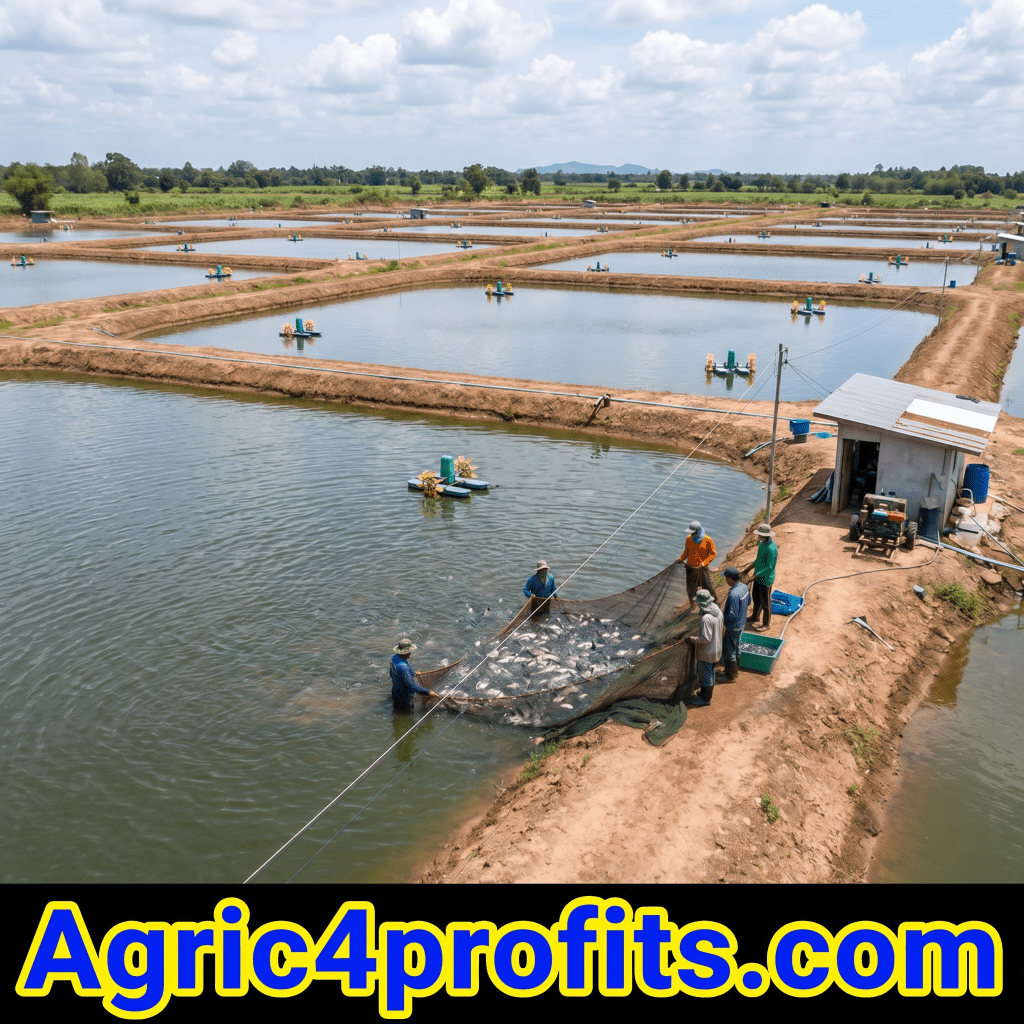
The pond or tank should be designed before a single fish arrives, because drainage, slope, depth, and access determine how easily you can manage water, harvest stock, and clean the system using drainage layout.
Circular tanks are popular for intensive farms because they improve water flow and make waste removal easier. Even when you use rectangular ponds, proper inlets and outlets still matter greatly, especially for waste removal.
📖 Want to Go Deeper on This Topic?
Our expert agricultural ebooks cover poultry, fish farming, different crops production, snail farming, organic farming, mushrooms, sheep, cattle, flowers, pig farming, goat farming, agribusiness, etc. in practical step-by-step detail — written by agricultural professionals for African farmers.
Stocking density must match oxygen supply and feeding capacity. Crowding fish beyond system capacity can reduce growth, while understocking wastes space and raises the cost of each kilogram produced over time by protecting oxygen supply.
A sensible design also separates nursery space from grow-out space. That division lets small fish start in gentler conditions and move into stronger production units only after they are ready, which supports nursery space.
For layout planning, compare the pond size, depth, and infrastructure to your expected harvest volume. Smart sizing keeps feeding efficient and helps you schedule cycles without overloading the farm system around your harvest volume.
Good aeration is essential in intensive systems because fish consume oxygen quickly, especially at night and during warm weather. Proper circulation also reduces dead zones and improves feed utilization daily with the right aeration choice.
Water quality should be checked regularly for pH, dissolved oxygen, temperature, and waste buildup. Stable readings support growth, while sudden changes can reduce appetite and increase mortality quickly over time through routine testing.
Design choices should also protect the surrounding environment. Clean drainage, safe handling, and controlled discharge reduce health risks and improve the reputation of the farm and nearby community as well, linking production to community health.
D. Water Quality, Oxygen, and Profit Protection
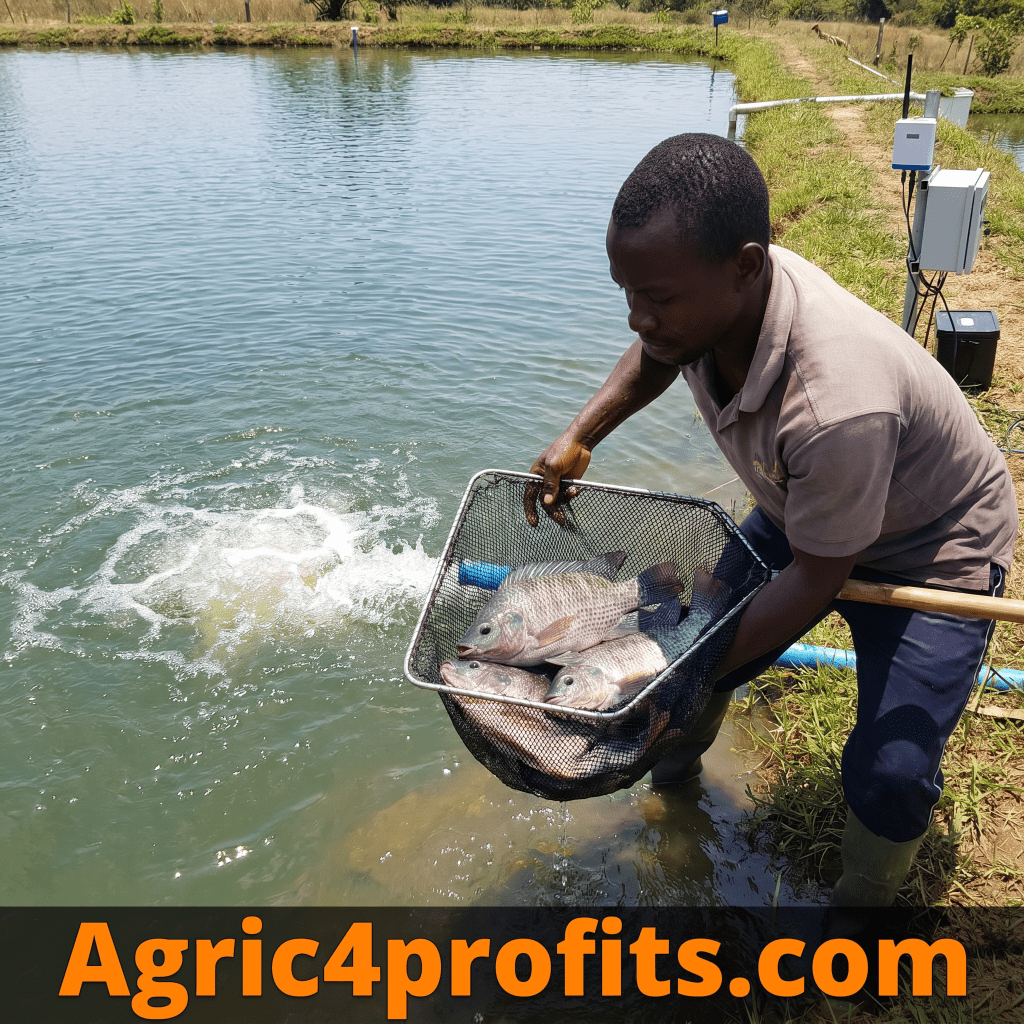
The image above reminds us that water quality management sits at the center of tilapia farming. Good water supports appetite, oxygen transfer, digestion, and waste breakdown, while poor water weakens the crop through chemistry.
A practical farm should monitor pH, dissolved oxygen, temperature, and carbon dioxide because these factors shape fish behavior every day. Small changes may look harmless at first, yet they often accumulate into losses through monitoring.
Tilapia can tolerate less-than-perfect water, but that tolerance should not encourage negligence. Clean water reduces disease pressure, improves feed conversion, and makes harvests safer for consumers and handlers every day.
pH works best in a stable range, because extreme acidity or alkalinity makes feeding less efficient. If pH drifts too high or too low, growth slows and stress increases quickly.
Dissolved oxygen must remain high enough to support respiration, especially in crowded tanks and hot weather. When oxygen falls, fish rise to the surface, eat poorly, and become vulnerable to sudden mortality.
Carbon dioxide should also be controlled, because excess gas can displace oxygen and create stressful conditions near the pond bottom. Good aeration and circulation help prevent that buildup before it damages production.
For profit, harvest at the right size and market at the right time. Buyers respond better when fish are uniform, healthy, and managed under a predictable feeding program after harvest.
A profitable farm also records feed use, mortalities, water tests, and sales. Those records reveal weak points early and help you decide whether to expand, restock, or change the production system.
Summary on How to Start a Tilapia Fish Farm
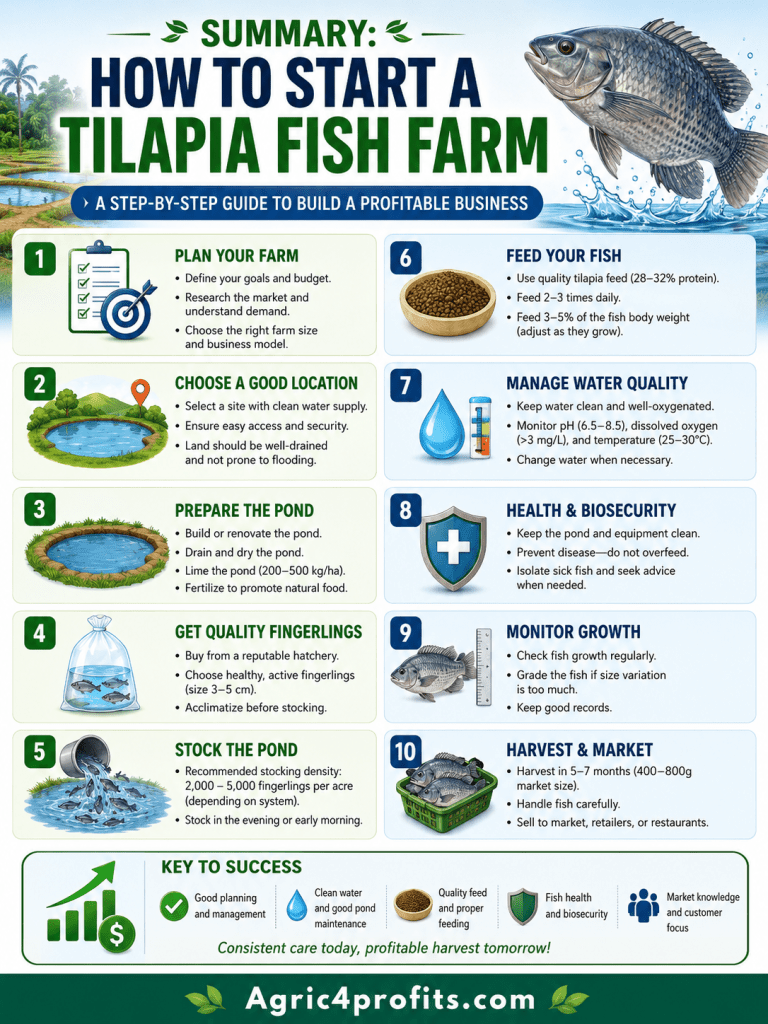
| Section | Main focus | Practical takeaway |
| Intro | Why tilapia farming needs planning | Match resources, climate, and market before investing. |
| A | Species selection | Choose strains that fit temperature, demand, and hatchery quality. |
| B | Stocking and feeding | Control density, reproduction, and nutrition to protect growth. |
| C | Pond design | Build for drainage, aeration, and harvest efficiency. |
| D | Water quality and profit | Monitor chemistry, harvest on time, and keep records. |
Frequently Asked Questions About How to Start a Tilapia Fish Farm
1. What tilapia strain suits beginners best?
Nile tilapia is usually the easiest starting point because it adapts well, grows quickly, and fits many pond systems. Beginners still need good fingerlings, clean water, and regular feeding to succeed.
2. How many fish should I stock at first?
Start with a stocking density that matches your aeration, water exchange, and feed supply. Smaller trial cycles help you learn faster, reduce risk, and avoid expensive losses caused by overcrowding.
3. Why does feed quality matter so much?
Feed drives growth, feed conversion, and profit. Poor feed wastes money, slows development, and increases pollution in the pond. Good formulations match fish size, stage, and management style more closely.
4. How often should I check water quality?
Check water daily in intensive systems and regularly in less intensive systems. pH, oxygen, temperature, and waste levels can change quickly, especially when feeding is heavy or weather becomes unstable.
5. Can tilapia survive in low-quality water?
Tilapia can tolerate more than many fish, but survival is not the same as profitable production. Clean water improves appetite, reduces disease, and protects the final market value of the crop.
6. What causes most tilapia farm failures?
Most failures come from weak planning, overcrowding, poor feed, bad water, and late harvesting. Problems also grow when farmers ignore local market demand, disease prevention, and regular record keeping practices.
7. Why use monosex tilapia in farming?
Monosex tilapia reduces uncontrolled breeding inside the pond. That keeps fish sizes more even, lowers competition for feed, and helps the farmer focus production on marketable growth instead of unwanted fry.
8. How do I know when to harvest?
Harvest when fish reach your target weight and the market price justifies selling. Uniform size, healthy body condition, and stable growth records usually signal that the crop is ready for sale.
Do you have any questions, suggestions, or contributions? If so, please feel free to use the comment box below to share your thoughts. We also encourage you to kindly share this information with others who might benefit from it. Since we can’t reach everyone at once, we truly appreciate your help in spreading the word. Thank you very much for your support and for sharing!
Read Also: Broccoli Farming 101: Tips and Techniques for a Thriving Crop
🌱 Take Your Farming Further With Agric4Profits
Based on what you just read, here are free resources and products from Agric4Profits that can help your farm right now:
- 🛒 Visit Our Marketplace — Organic neem oil, bio-pesticides, seeds and farming products
- 📚 Read Premium Content — Advanced guides for serious and profitable farming
- 🎓 Join Our Free Academy — Structured free training for farmers across Africa
- 🔧 Use Our Free Farm Tools — Profit calculators, feed formulation, pest identifier and more
- 💬 Join Our Farming Community — Connect with farmers across all 54 African countries
- ❓ Ask a Farming Question — Get answers from experienced farmers and agricultural experts



.png)
