
 5 months ago
308
5 months ago
308

.jpeg)
.png)
The variety of fish body shapes refers to the different forms and structures that fish bodies can have. These shapes help fish survive efficiently in their specific environments and daily routines.
The great ecological diversity of fish is reflected in the astonishing variety of body shapes and means of locomotion they possess. Much about a fish’s ecology can be learned from its anatomy.
Each shape is adapted to the fish’s lifestyle, making it better at finding food, escaping predators, and moving through its habitat with less effort and greater overall survival success.
Read Also: Fish Biology: Anatomy, Physiology, Embryology and Endocrinology for a fuller discussion of fish anatomy, physiology, embryology, and endocrinology, which complements the body-shape concepts explained in this article and deepens biological understanding.
1. Basic Piscine Shapes (Fish Body Shapes)
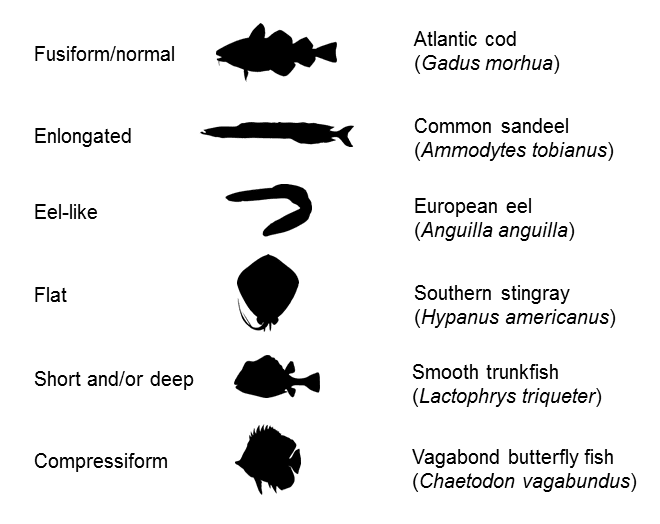
Most fishes fall into broad body categories that reflect where they live, how they move, and how they capture food. Body configuration often reveals more about a species than color alone ever could.
i. Fusiform: Fusiform bodies are streamlined for speed in open water. Barracuda and tuna use this shape to reduce drag, chase prey, and cover long distances with less effort overall.
ii. Laterally compressed: Laterally compressed bodies are flattened from side to side, giving fish excellent maneuverability around reefs, weeds, and complex habitats. Angelfish and schooling species use this design to turn quickly and avoid danger.
iii. Depressed: Depressed bodies are flattened from top to bottom and are common among bottom-dwelling species. Rays and many benthic fish stay close to the substrate, where the body helps them rest, hide, and feed.
iv. Surface-oriented: Surface-oriented fish live close to the top layer of water and often feed on insects or drifting prey. Their bodies help them stay near the surface while scanning for food and threats.
v. Eel-like: Eel-like bodies are long, narrow, and flexible, allowing fish to slip into crevices, burrow into soft bottoms, or move through dense vegetation. Moray eels rely on this shape for stealth.
vi. Globiform: Globiform bodies are round, bulky, and often defensive in appearance. Pufferfish use this compact design with other defenses, making them awkward swimmers but difficult prey in nature and defense.
2. Other piscine features

Other piscine features add another layer of identification because shape alone does not explain everything. Tail design, mouth position, and color pattern often reveal how a fish behaves in daily life.
Crescent-shaped tails support speed and endurance, so fish that depend on open water travel often show this design. These tails reduce drag and help active species stay efficient during pursuit.
Forked tails also suggest strong swimming ability, especially when the fork is deep and narrow. Such fish usually keep moving, because the tail design favors long-distance travel and steady propulsion.
Rounded tails are more useful for control than speed, making them common in fish that weave through cover, roots, or rocky spaces. They help the fish turn quickly and hold position.
Mouth position remains one of the most useful clues for understanding feeding habits. Terminal mouths suit pursuit, up-pointing mouths suit surface feeding, and sub-terminal mouths suit bottom feeding and scavenging.
Colour patterns close the picture by supporting camouflage, warning, mimicry, or deception. Boxfish, porcupine fish, and other unusual forms show that body design can trade speed for defense in nature.
Read Also: Introduction to Fishing Gear Technology for practical context on fishing tools, capture methods, and field techniques that connect neatly with fish form, function, and everyday farming decisions overall.
3. Functional body form and identification

Fish shape is closely tied to ecology, so classification often begins with external observation. Researchers study the outline, fin arrangement, mouth position, and scale pattern before moving to finer anatomical details.
That approach is supported by morphology and basic structure, external anatomy, and ichthyology because these topics explain how visible traits relate to feeding, movement, and identification in practical field work.
In open water, streamlined fish usually need strong swimming muscles and efficient tails, while reef species depend more on maneuverability. Shape therefore acts as a shortcut for predicting how a species behaves.
Bottom-associated species often show flattened heads, ventral mouths, or enlarged pectoral fins. Those features reduce resistance near the substrate and help the fish settle, rest, or feed in currents daily.
Even within one family, body form can vary with habitat pressure, food supply, and predator risk. That is why aquaculture studies regularly connect form with habitat classification and fish biology.
When farmers understand the link between anatomy and environment, they choose more suitable stocking, feeding, and pond-management practices. This is especially useful in fish farming and pond management in practice.
4. Shape, feeding, and growth management

Body shape also influences how fish reach food and how efficiently they use it. Fast swimmers need different feeding strategies from bottom dwellers, surface feeders, or species that wait quietly for passing prey.
In aquaculture, this matters because the wrong feed style can waste money and slow growth. Farmers benefit when they match feeding systems with species behavior, water depth, and natural swimming pattern.
Articles on feeding points, feed types, fish nutrition, and proper feed formulation show how food placement and pellet quality improve intake. These details matter because fish feed remains one of the highest farm costs.
Careful feeding is also linked to growth performance, so management practices should support digestion rather than stress. That is why studies on feed conversion, growth rate, and catfish development remain valuable.
Pelletizing and balanced ration design can improve stability, reduce waste, and help fish eat more consistently. When feed matches mouth size and swimming style, the farm usually records better results.
Farmers who understand these relationships can adjust ration size, feeding frequency, and feed texture more confidently. This reduces competition at feeding time and supports steady growth across the stock overall.
5. Habitat, water quality, and survival

Fish shape usually reflects the habitat where the species spends most of its life. Open-water hunters, reef dwellers, stream specialists, and bottom residents all face different physical pressures that shape their bodies.
Laterally compressed fish turn well in coral reefs and submerged vegetation, while fusiform fish thrive in open water where speed matters more than sharp turns during movement in crowded systems.
Depressed forms stay close to the bottom for safety, which is why classification based on habitat remains practical in farming. Water balance also matters, so water quality must stay stable.
Habitat also influences oxygen demand, water movement, and stress tolerance. Fish in crowded or poorly aerated systems struggle when conditions become unsuitable, which is why oxygen levels and pond water quality deserve close attention.
Practical articles on fish pond and its associated health hazards show that poor conditions can quickly reduce feeding activity and survival. Healthy fish forms still depend on suitable dissolved oxygen, temperature, and cleanliness.
That is why habitat-based classification is useful in both biology and farming. It connects form with function and helps farmers interpret the needs of each stock more accurately over time.
Understanding habitat relationships also guides species choice, pond design, and stocking density. When the environment matches the fish body plan, the stock usually grows better and experiences less stress overall.
6. Practical applications for farmers

Fish body shape is more than a theory lesson; it affects everyday farm decisions. Stocking, grading, feeding, and harvesting all work better when the farmer understands how form affects behavior.
Mixing fish of very different sizes can create feeding competition and stress, especially when body shapes also differ. Farmers who study juvenile development and growth patterns usually manage their stock more successfully.
Breeding and hatchery work also benefit from shape awareness because broodstock condition, spawning behavior, and early development influence later form. Related guidance on induced spawning and hatchery management remains especially helpful.
Anatomical observation supports species identification, meristic counting, and external feature analysis. These tools help farmers and students distinguish fish more accurately, especially when dealing with similar-looking species in markets and ponds.
Good pond management, water testing, and disease prevention keep body shape advantages from being undermined by poor conditions. Healthy fish still need clean water, balanced nutrition, and stable management routines.
Once these basics are in place, farmers can make better choices about species selection, culture systems, and feed timing. Shape then becomes a practical tool, not just a descriptive biological term overall.
Read Also: Impact of Agricultural Wastes on Human and Environment for a wider environmental perspective on how human activities influence aquatic systems, fish health, and sustainable management choices today overall.
Summary on The Variety of Fish Body Shapes

| Body shapes | Fish body form shows how a species moves, feeds, and escapes danger. | Shape helps predict behaviour and habitat use. |
| Secondary features | Tails, mouths, and colour patterns sharpen identification. | These features reveal feeding depth and swimming style. |
| Ecology | Body design reflects habitat, oxygen demand, and stress tolerance. | Matching form with environment supports survival. |
| Aquaculture | Shape knowledge improves feeding, grading, breeding, and pond management. | Farmers make smarter, lower-waste decisions. |
Frequently Asked Questions About The Variety of Fish Body Shapes
1. Why does a fish’s body shape matter so much when you are trying to understand its ecology, feeding habits, swimming ability, and likely habitat in both the wild and aquaculture systems today?
Body shape gives immediate clues about movement, feeding level, and habitat preference. It helps biologists and farmers predict behavior, reduce mistakes, and choose better management practices for each species overall.
2. How can tail shape help a farmer or student tell whether a fish is built for speed, maneuverability, endurance, or short bursts of movement inside crowded ponds or natural habitats?
A crescent or forked tail usually supports speed and endurance, while a rounded tail favors quick turns and short bursts. This helps explain how the fish will move, escape, and feed.
3. What is the practical value of knowing whether a fish has a terminal, up-pointing, or sub-terminal mouth before choosing feed, pond setup, stocking strategy, or feeding schedule in practice daily?
Mouth position shows where the fish feeds and what size food it can handle. That knowledge helps farmers place feed properly, choose pellet size wisely, and reduce waste during feeding.
4. Why are color patterns such as counter-shading, camouflage, disruptive coloration, and eye spots important in fish survival, predator avoidance, and species identification in field and farm settings overall daily widely?
These patterns help fish avoid predators, blend with their surroundings, or confuse attacks. They also make identification easier once you know which markings are tied to specific habitats or families.
5. How do water quality and dissolved oxygen interact with fish body form, especially when fish are kept in crowded ponds, stressed environments, or poorly managed culture systems for long periods?
Even well-adapted body shapes fail under poor water conditions. Fish need adequate oxygen, stable temperature, and clean water to feed properly, avoid stress, and maintain normal growth and activity overall.
6. How can farmers use body shape knowledge to improve feeding, grading, breeding, and general pond management without adding unnecessary cost or making their everyday decisions more complicated in practice overall?
Farmers can match feed style, stocking density, and management routines to the species’ body plan. That reduces competition, improves efficiency, and makes everyday decisions more precise and profitable overall consistently.
Do you have any questions, suggestions, or contributions? If so, please feel free to use the comment box below to share your thoughts. We also encourage you to kindly share this information with others who might benefit from it. Since we can’t reach everyone at once, we truly appreciate your help in spreading the word. Thank you very much for your support and for sharing!
Read Also: Impact of Agricultural Wastes on Human and Environment





.png)
