



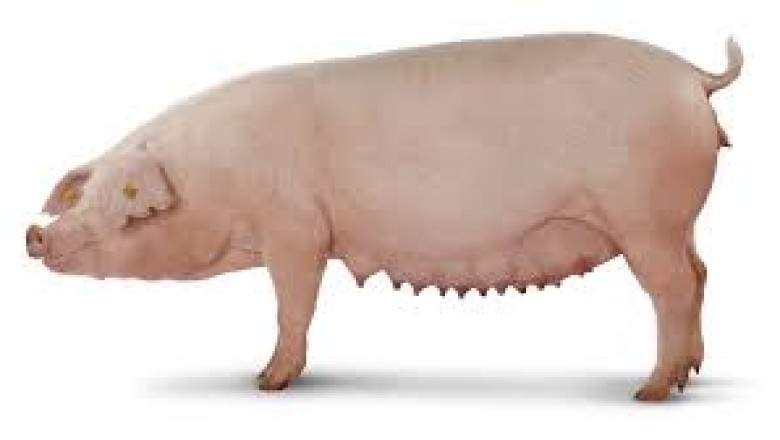

= History of the Landrace Pig
The **Landrace breed** originated in **Denmark in the late 19th century**. Danish farmers developed the breed by crossing local pigs with Large White (Yorkshire) pigs from England. Their aim was to produce a pig that excelled in bacon production—long, lean, and with a high proportion of usable meat.
By the early 20th century, Danish Landrace pigs gained worldwide recognition, particularly for their ability to produce high-quality bacon with just the right balance of lean meat and fat. Soon after, the breed spread across Europe, North America, and Asia.
Today, many countries maintain their own Landrace populations—such as **American Landrace, British Landrace, and South African Landrace**—adapted to local conditions but still maintaining the breed’s core qualities.
---
= Physical Characteristics
The Landrace is easily recognizable by its distinctive appearance:
* **Size**: Medium to large, with boars weighing 300–400 kg and sows around 250–330 kg.
* **Body Shape**: Extremely long and deep-bodied, ideal for producing long cuts of bacon.
* **Color**: White skin and hair, similar to the Yorkshire, but with fewer freckles or dark spots.
* **Ears**: Large, floppy ears that droop forward and often cover part of the eyes.
* **Legs**: Strong, though the long body requires careful selection to prevent structural weaknesses.
This body structure makes the Landrace highly valued in pork processing plants where carcass length translates into greater meat yield.
---
= Temperament and Adaptability
Landrace pigs are generally calm, manageable, and **less aggressive** than some other breeds, making them easier for farmers to handle. They adapt well to intensive commercial production systems and can also be raised in outdoor systems if properly managed.
However, because of their **white skin**, Landrace pigs are prone to sunburn in hot climates. Farmers raising them outdoors often provide shade, mud wallows, or shelters to protect them from heat stress.
---
= Growth and Production Traits
Landrace pigs are highly efficient in converting feed into muscle, making them popular in commercial pork systems.
* **Growth Rate**: They grow rapidly and reach market weight (90–120 kg) within 5–6 months.
* **Feed Efficiency**: They require less feed per kilogram of weight gain compared to less-optimized breeds.
* **Carcass Quality**: Long, lean carcasses with excellent muscle-to-fat ratios, ideal for bacon and high-value cuts.
* **Meat Traits**: Meat is tender, lean, and has just enough fat to ensure good flavor and processing quality.
This balance of **quantity and quality** explains why Landrace pork is highly demanded in global markets.
---
= Breeding and Reproduction
Landrace pigs are regarded as one of the best **maternal breeds** in the world. Their reputation is built on:
* **Large Litters**: Sows often farrow **10–14 piglets** per litter, sometimes even more.
* **Excellent Mothering**: Landrace sows are attentive mothers, with high milk production, ensuring high survival rates for piglets.
* **Fertility**: They are fertile and can farrow multiple times per year, maintaining productivity over several cycles.
* **Longevity**: Many Landrace sows remain productive for longer periods compared to other breeds.
Because of these strengths, Landrace pigs are widely used as the **maternal line** in crossbreeding programs, while terminal sire breeds (such as Duroc or Hampshire) provide the growth and meat traits.
---
= Role in Crossbreeding Programs
Landrace pigs have become central to modern pork production through **hybrid breeding systems**.
* **Landrace × Yorkshire (Large White)**: Produces exceptional mothering sows, commonly known as “F1 sows.” These crossbred females combine the reproductive ability of Landrace with the hardiness of Yorkshire.
* **Terminal Crosses**: F1 sows are often bred with Duroc, Hampshire, or Pietrain boars to produce market pigs that grow fast, are feed-efficient, and produce high-quality pork.
* **Hybrid Vigour**: Crossbreeding with Landrace enhances fertility, growth rates, and survival, maximizing farm profitability.
Without the Landrace, global commercial pig production would not have achieved the efficiency it enjoys today.
---
= Feeding and Nutrition
Landrace pigs thrive on a balanced diet of energy, protein, vitamins, and minerals. Their diet typically includes:
* **Cereals** (corn, barley, wheat) for energy.
* **Soybean meal or fishmeal** for protein.
* **Vitamins and minerals** for bone health and reproduction.
* **Forages and root crops** in traditional systems.
Because of their large litter sizes and rapid growth, Landrace pigs require high-quality feed. Lactating sows, in particular, need additional protein and energy to support both themselves and their piglets.
---
= Health and Management
Landrace pigs are generally hardy, but due to their white skin and large body size, they require specific management considerations:
* **Sun Protection**: Shade or mud is essential in hot climates.
* **Leg Strength**: Selective breeding is important to prevent weak legs or structural issues due to their long frames.
* **Biosecurity**: Vaccinations, parasite control, and clean housing are critical in intensive systems.
* **Stress Reduction**: Proper handling reduces stress, which can affect growth and reproduction.
Well-managed Landrace herds can have low mortality and high productivity, making them profitable for farmers.
---
= Economic Importance
The economic contribution of Landrace pigs to the global pork industry is enormous:
* **Foundation of Maternal Lines**: Almost all major commercial pig production systems use Landrace genetics.
* **Carcass Quality**: High-value cuts and bacon production drive consumer demand.
* **Breeding Stock**: Purebred Landrace animals are essential in genetic improvement programs worldwide.
* **Global Reach**: From Europe and North America to Asia and Africa, Landrace pigs play a role in food security and farm incomes.
The combination of reproductive efficiency and meat quality ensures their continued importance in pork production.
---
= Challenges in Raising Landrace Pigs
While highly productive, Landrace pigs also come with some challenges:
* **Sun Sensitivity**: Like Yorkshire, their white skin is prone to sunburn.
* **Structural Issues**: Long bodies can lead to weak backs or legs if breeding selection is poor.
* **High Nutritional Needs**: Large litters and rapid growth require nutrient-dense feed, increasing production costs.
* **Specialized Care**: Farmers must balance litter size with sow health to avoid over-stressing mothers.
Despite these challenges, careful breeding and management make Landrace pigs one of the most profitable choices.
---
= Landrace Pork in the Global Market
Landrace pork is valued worldwide, particularly in **bacon production**. Their long, lean carcasses are ideal for producing high-yield bacon sides with consistent quality. In addition, their meat is widely used in:
* **Fresh cuts** like chops, loins, and hams.
* **Processed products** such as sausages, ham, and cured meats.
* **Hybrid pork production**, where Landrace crosses ensure a balance of lean meat and flavor.
This global market demand makes the breed indispensable to processors, retailers, and consumers alike.
---
= Conclusion
The **Landrace pig** is rightly regarded as one of the most influential pig breeds in modern agriculture. Known for its reproductive power, mothering ability, and carcass quality, the Landrace has become the cornerstone of maternal lines in commercial pork systems.
From its origins in Denmark to its spread across the globe, the Landrace has shaped how pork is produced, processed, and consumed. Whether as a pure breed or in crossbreeding programs, it continues to deliver efficiency, profitability, and high-quality pork to farmers and consumers worldwide.
Simply put, without the Landrace, the global pork industry would look very different today.











Comments
0 comment