



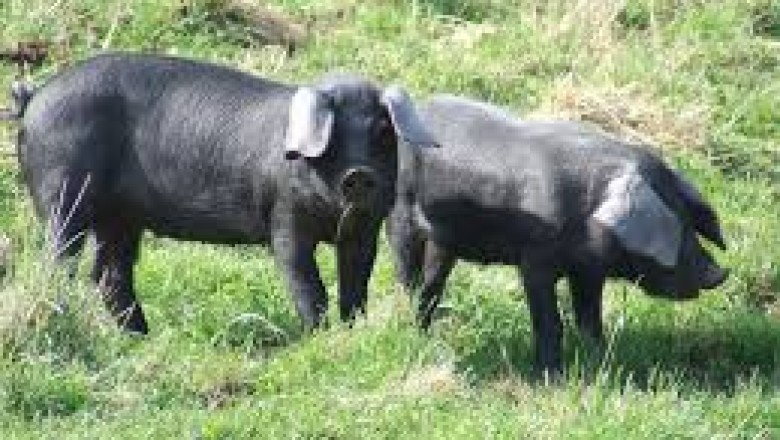

= Origin and History
The **Large Black pig** originated in England during the late 19th century through the combination of local black pigs from Devon, Cornwall, and Essex. Farmers selectively bred them for size, hardiness, and quality meat. By the early 20th century, the Large Black had gained widespread popularity, particularly for its ability to thrive on pasture-based systems.
At its peak, the breed was exported to countries like the United States, Australia, and parts of Africa. In the U.K., the breed became a preferred choice for bacon production due to its balance of lean meat and flavorful fat.
However, with the rise of commercial intensive pig farming after World War II, the Large Black declined in numbers because it matured slower and had more fat compared to “modern” commercial breeds like the Landrace or Yorkshire. Today, the breed is considered **rare or endangered in many regions**, but conservation efforts are keeping its legacy alive.
---
= Physical Characteristics
The Large Black pig is immediately recognizable due to its:
* **Color**: Entirely black coat, which helps reduce sunburn when raised outdoors.
* **Size**: A large-framed pig, with boars weighing between **700–800 pounds (320–360 kg)** and sows around **600–700 pounds (270–320 kg)** when mature.
* **Ears**: Long, floppy ears that often cover the pig’s eyes, shading them from sunlight while foraging.
* **Body**: Long, deep body with good capacity for feed conversion and carcass yield.
* **Legs**: Strong and well-boned, making them excellent walkers and grazers.
This breed is slow to mature compared to commercial strains, but its hardiness and adaptability to pasture-based systems make it a favorite among sustainable farmers.
---
= Temperament and Behavior
The Large Black pig is known for its **docile and calm temperament**, making it relatively easy to manage. Farmers often describe them as gentle giants, well-suited for both small-scale family farms and rotational grazing systems.
Key behavioral traits include:
* **Excellent Foragers**: They thrive in outdoor systems, efficiently grazing and rooting for food.
* **Mothering Ability**: Large Black sows are renowned for producing **large litters (8–12 piglets on average)** and being attentive, protective mothers.
* **Adaptability**: They handle various climates well, though they particularly excel in temperate to warm regions.
* **Social Nature**: They are herd animals and perform best when kept in groups.
Because of their strong foraging instincts, they are well-suited to low-input, pasture-based pork production systems.
---
= Growth and Production
=# Growth Rate
Large Black pigs grow more slowly compared to fast-growing commercial breeds such as the Yorkshire or Duroc. However, their growth rate is balanced by their ability to **convert forage and lower-quality feed into high-quality pork**, reducing overall feed costs in outdoor systems.
* Market weight: Typically achieved at **6–8 months of age** (250–300 pounds or 110–135 kg).
* Slaughter weight: Can vary depending on market, often between **280–320 pounds** for pork and bacon production.
=# Reproduction
* **Litter size**: Average 8–12 piglets, with occasional litters exceeding 12.
* **Mothering skills**: Large Black sows produce plenty of milk and have strong maternal instincts, reducing piglet mortality.
---
= Pork Quality
One of the biggest strengths of the Large Black pig is the **exceptional quality of its pork**.
* **Flavor**: Rich, succulent, and well-marbled.
* **Fat**: Slightly higher fat content compared to lean commercial breeds, but this enhances juiciness and taste.
* **Texture**: Tender meat with excellent intramuscular fat distribution.
* **Specialty Uses**: Highly prized for **bacon, charcuterie, and traditional British pork products**.
Chefs and specialty pork markets often pay a premium for Large Black pork, as consumers increasingly appreciate flavor and ethical production over sheer leanness.
---
= Advantages of Large Black Pigs
1. **Hardiness** – Adaptable to outdoor systems, resistant to sunburn due to black coat.
2. **Excellent Foragers** – Thrive on pasture, reducing dependence on expensive commercial feed.
3. **Superior Mothering** – Large litter sizes and strong maternal instincts.
4. **Pork Quality** – Rich flavor and marbling, highly valued in specialty markets.
5. **Docile Nature** – Easy to handle and manage.
6. **Conservation Value** – Helps preserve genetic diversity in pig farming.
---
= Challenges of Large Black Pigs
1. **Slower Growth** – Longer time to reach market weight compared to modern breeds.
2. **Higher Fat Content** – Not ideal for markets demanding lean pork.
3. **Conservation Status** – Relatively low numbers worldwide, making breeding stock harder to find.
4. **Visibility Issues** – Long floppy ears sometimes obstruct vision, though this does not usually affect health.
5. **Commercial Competition** – Cannot compete with industrial breeds in high-intensity farming systems.
---
= The Role in Modern Farming
Although the Large Black pig has been overshadowed by commercial breeds in intensive farming, it has found a strong niche in **sustainable and small-scale pork production**.
* **Pasture-Based Farms**: Farmers who prioritize low-input systems appreciate the breed’s ability to thrive on grass and forage.
* **Niche Pork Markets**: Consumers willing to pay extra for superior flavor and ethically raised meat create demand for Large Black pork.
* **Heritage Breed Preservation**: Breeding programs in the U.K., U.S., and Australia are working to increase population numbers.
Organizations such as the **Rare Breeds Survival Trust (RBST)** in the U.K. and the **American Livestock Conservancy** in the U.S. have listed the Large Black as a priority breed for conservation, highlighting its genetic and cultural importance.
---
= Large Black Pork in the Culinary World
Chefs and food enthusiasts regard Large Black pork as one of the best-tasting pork varieties available. It is particularly valued for:
* **Bacon**: Balanced fat-to-meat ratio, producing flavorful rashers.
* **Roasts**: Succulent and tender, with natural marbling.
* **Charcuterie**: Perfect for cured meats such as prosciutto, salami, and sausages.
* **Farm-to-Table Dining**: Many restaurants highlight Large Black pork on menus as a heritage, sustainable option.
---
= Conservation and the Future
The Large Black pig population declined drastically in the mid-20th century but has seen a modest resurgence thanks to the growing demand for **heritage meats** and **ethical farming practices**.
* **Conservation Programs**: Breeders’ associations encourage cross-farm breeding to maintain genetic diversity.
* **Consumer Awareness**: Increasing recognition of the importance of heritage breeds helps sustain demand.
* **Sustainable Farming**: As regenerative agriculture and pasture-based systems gain momentum, the Large Black is well-positioned to play an important role.
---
= Conclusion
The **Large Black pig** is more than just a visually striking heritage breed—it represents a critical piece of agricultural history and a promising future for sustainable pork production. Its **hardiness, mothering ability, excellent foraging skills, and richly flavored pork** make it a valuable asset for small farms and niche markets. While it may not compete with high-efficiency commercial breeds in intensive systems, the Large Black thrives where natural grazing, ethical farming, and premium-quality pork are valued.
By supporting conservation and choosing heritage pork, farmers and consumers alike can ensure that the **Large Black pig** continues to play a role in global pig farming for generations to come.
-










Comments
0 comment