





= Origins and History
The Gir breed originated in the **Gir Forest region of Gujarat, India**, which gives the cattle their name. For centuries, pastoral communities such as the Maldharis of Gujarat have bred and raised Gir cattle, valuing them for their milk and hardiness in hot, semi-arid climates.
During the late 19th and early 20th centuries, Gir cattle were exported to Brazil and other Latin American countries. There, the breed adapted exceptionally well and became a foundation for tropical dairy improvement programs, including the development of the Girolando (Holstein x Gir cross).
Today, while Gir cattle remain deeply rooted in Indian dairy culture, they also serve as a genetic resource for improving dairy production worldwide.
---
= Physical Characteristics
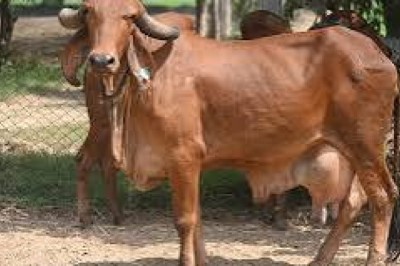
The Gir breed is easily recognizable and distinct among Indian Zebu cattle. Its physical traits include:
* **Coat Color**: Typically red, white, or spotted red-and-white, with great variation in patterns.
* **Head**: Convex forehead, often referred to as a "dished face," which is a hallmark of the breed.
* **Ears**: Long, pendulous, and curled like a tulip.
* **Horns**: Curved, bending backward and outward.
* **Size**: Mature cows weigh between 400–550 kg (880–1,200 lbs), and bulls can weigh 800–1,000 kg (1,760–2,200 lbs).
* **Skin**: Loose, pigmented skin that helps in heat regulation and resistance to parasites.
This combination of features contributes to the breed’s unique beauty and adaptability to tropical environments.
---
= Adaptability and Resilience
Gir cattle have evolved to thrive in **hot, humid, and semi-arid climates** where many European dairy breeds would struggle. Their adaptability is reflected in:
1. **Heat Tolerance** – Loose skin, large ears, and efficient sweating mechanisms allow them to withstand high temperatures.
2. **Parasite Resistance** – Gir cattle show natural resistance to ticks and common tropical parasites.
3. **Forage Efficiency** – They can thrive on low-quality, fibrous grasses typical of semi-arid regions.
4. **Disease Resistance** – Less prone to tropical diseases like tick fever compared to exotic breeds.
5. **Endurance** – Strong walking ability allows them to graze over long distances.
These traits make Gir cattle especially valuable for smallholder farmers in rural India who rely on extensive grazing systems.
---
= Dairy Qualities
The Gir breed is renowned for its **milk production and composition**.
* **Milk Yield**: On average, Gir cows produce between **2,000 and 3,000 liters per lactation**, though elite individuals can yield over 4,000 liters under good management.
* **Milk Fat Content**: Gir milk has a butterfat content of **4.5–5%**, making it ideal for producing ghee, butter, yogurt, and traditional Indian sweets.
* **A2 Protein**: Gir cows produce **A2 beta-casein protein milk**, believed to be easier to digest and healthier than A1 milk, which is common in many European breeds.
* **Lactation Period**: Extended lactations provide steady milk supply for families and markets.
Because of these qualities, Gir milk is highly valued in India and is increasingly marketed as **premium A2 milk** for health-conscious consumers.
---
= Reproductive and Maternal Traits
Gir cows are prized for their reproductive efficiency and mothering abilities, which include:
* **Fertility** – Strong reproductive performance even in challenging conditions.
* **Calving Ease** – Small to medium-sized calves at birth reduce complications.
* **Maternal Care** – Strong instincts to protect and nurture calves.
* **Longevity** – Productive life spans often exceed 12–15 years, lowering replacement costs.
These qualities ensure the breed remains economically viable for traditional and modern dairy farmers alike.
---
= Cultural and Religious Importance
In India, cattle hold deep cultural and spiritual significance, and the Gir breed is no exception. Gir cows are often associated with **prosperity, nourishment, and fertility**. In Hindu tradition, cows are considered sacred, and Gir cows, with their docile nature and abundant milk, are especially revered.
In Gujarat, the breed is celebrated as part of the region’s heritage. Festivals, fairs, and breeding programs highlight the importance of the Gir in rural life. The cow’s ghee and milk products are often used in religious rituals and temple offerings.
---
= Global Influence
Beyond India, the Gir breed has made an international mark, particularly in **Brazil**, where it was imported in the early 20th century. Brazilian breeders improved Gir genetics for dairy production, creating some of the highest-yielding Gir herds outside India.
One of the breed’s greatest contributions is its role in crossbreeding. The **Girolando**, a cross between Gir and Holstein, has become Brazil’s dominant dairy breed, combining Holstein’s high milk output with Gir’s tropical adaptability.
Gir genetics have also been exported to Africa, Central America, and Southeast Asia, where they continue to improve dairy productivity under hot conditions.
---
= Challenges and Criticisms
While Gir cattle are highly valued, they face certain challenges:
* **Lower Yield Compared to Holstein**: Purebred Gir cows produce less milk than European breeds under intensive systems.
* **Temperament**: Some Gir cows can be nervous or aggressive, though careful handling reduces issues.
* **Breed Conservation**: Pure Gir populations in India need continued conservation efforts to prevent dilution from crossbreeding.
Despite these limitations, the breed’s advantages in tropical regions far outweigh its drawbacks.
---
= Role in India’s Dairy Industry
India’s **Operation Flood** (White Revolution) in the 1970s transformed the country into a global leader in milk production. While exotic breeds like Holstein and Jersey were introduced, indigenous breeds such as Gir remained crucial for sustainable dairying in hot regions.
Today, Gir cattle are central to India’s push for **A2 milk markets**, as consumers increasingly demand natural and healthier alternatives. Breeding programs across Gujarat, Rajasthan, and Maharashtra continue to preserve and improve the breed.
---
= Sustainability and Future Outlook
With global temperatures rising and sustainability becoming a priority, the Gir breed is more relevant than ever. Its ability to produce milk efficiently on **pasture-based, low-input systems** makes it an eco-friendly choice. Additionally, its A2 milk gives it a competitive advantage in health-conscious dairy markets.
Future efforts will likely focus on:
* Expanding **A2 milk branding** using Gir milk.
* Strengthening **conservation programs** in India to protect purebred herds.
* Leveraging **crossbreeding** to improve milk yields in tropical countries.
* Promoting **climate-resilient dairy farming** with indigenous breeds.
---
= Conclusion
The Gir breed is more than just a dairy animal; it is a symbol of India’s cultural heritage, agricultural resilience, and contribution to global food security. From the **Gir Forest of Gujarat** to dairy farms across Brazil and beyond, the breed has proven its worth as a sustainable, adaptable, and productive dairy cow.
With its heat tolerance, disease resistance, fertility, and high-quality **A2 milk**, the Gir continues to empower farmers and nourish families in India and tropical regions worldwide. As the world looks toward more climate-resilient and health-conscious dairy farming, the Gir breed will undoubtedly play a central role in shaping the future.









Comments
0 comment